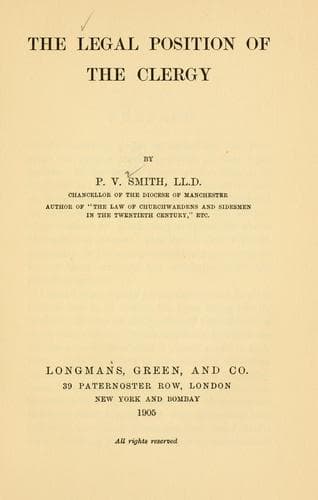
The Legal Position of the ClergySmith, Philip Vernon
Religion
The Legal Position of the Clergy
Smith, Philip Vernon
Canon law; Clergy -- Legal status, laws, etc. -- Great Britain; Ecclesiastical law -- Great Britain
16. Although there is no positive rule of law on the subject, an
incumbent should, as a matter of prudence, obtain a faculty, or at any
rate the written consent of the bishop and patron, before making any
substantial alteration in the parsonage house or other buildings of the
benefice. If he fails to do so, he proceeds at the risk of himself and
his estate; and if his action is afterwards challenged, it will lie upon
him or his executors to prove that it was justifiable.[362] The
precaution should never be omitted in the case of removing a building
without erecting another in its place. With regard to any building
belonging to or forming part of a parsonage house which appears to be
unnecessary, the bishop, on the application of the incumbent, and with
the written consent of the patron, is expressly empowered to authorise
its removal; and any net proceeds of the removal will be applied to the
improvement of the benefice in such manner as the bishop and patron may
agree.[363] The foregoing remarks do not apply to structures such as
movable sheds or garden frames, which are not regarded in law as affixed
to the soil and therefore hereditaments like the land on which they
stand, nor to fancy structures with which the succeeding incumbents
ought not to be burdened.[364]
17. Upon the vacation of a benefice, the incumbent or his estate ceases
to be entitled to the income and house of residence of the benefice. But
on the death of a married incumbent who was at the time occupying the
house of residence, his widow has a right to remain in occupation for
two months after his death;[365] and in every case, until the question
of dilapidations is settled, the late incumbent or his executors or
administrators may, at reasonable hours, with a surveyor, enter upon the
premises of the vacated benefice.[366] If the vacancy occurs otherwise
than by resignation, the late incumbent or his executors or
administrators have a right to emblements, that is to say, to reap and
enjoy any crops which he sowed before the vacancy occurred but which
have not ripened until afterwards.[367] Where, however, the glebe land
is not cultivated by the incumbent himself, but is let to tenants, the
current rents are in all cases apportionable between the late incumbent,
or his estate, and the new incumbent, up to and from the date of the
occurrence of the vacancy; and the same rule applies to tithe rentcharge
and to any other income from endowments.[368] Subject to these rights
and to provision being made out of the revenue of the benefice for the
service of the cure during the vacancy,[369] the new incumbent, on his
admission, becomes entitled to the temporalities of the benefice as from
the date when the vacancy took place.
Public-domain text, read in full here on John Shaqi.
Reviews
Reviews
No reviews yet
Be the first to share your thoughts on this work.
Elsewhere in the archive
Join the Discussion
Join the discussion
Sign in to leave a comment or review.
Sign InorCreate an account