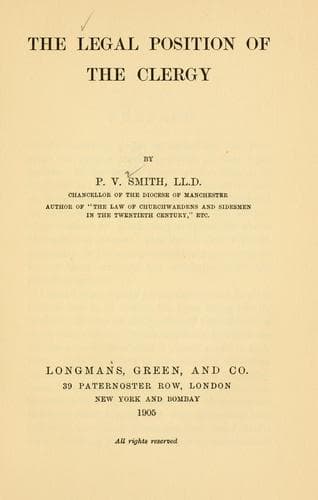
The Legal Position of the ClergySmith, Philip Vernon
Religion
The Legal Position of the Clergy
Smith, Philip Vernon
Canon law; Clergy -- Legal status, laws, etc. -- Great Britain; Ecclesiastical law -- Great Britain
18. Under the Tithe Act, 1836,[370] and various amending Acts, a tithe
commutation rentcharge has now been substituted for all the ancient
tithes, except tithes of fish or of fishing, personal tithes (other than
the tithes of mills), mineral tithes, payments instead of tithes within
the City of London, permanent rentcharges or other payments in lieu of
tithes calculated on the rent or value of houses or lands in a city or
town under a custom or private Act, and tithes commuted or extinguished
under a previous Act. And any of the excepted tithes and payments, as
well as Easter offerings, mortuaries, and surplice fees, could be
brought within the operation of the Acts by special provisions inserted
in the parochial agreements framed under the Acts and approved by the
Tithe Commissioners.[371] Where the rectory is impropriate and there is
a vicarage, the tithe commutation rentcharge payable to the rector has
been assessed in lieu of the rectorial or great tithes, namely, those
on corn, hay and wood, and the rentcharge payable to the vicar has been
assessed in lieu of the vicarial or small tithes, those on fruits,
herbs, live stock, poultry, milk, cheese, and eggs. Under the earlier
Acts an extraordinary tithe rentcharge was leviable on lands for the
time being cultivated as hop gardens, orchards, fruit plantations, and
market gardens; but this special rentcharge has since been abolished,
the lands which had been in practice liable to it having been made
liable to a fixed additional rentcharge instead.[372] The ordinary tithe
rentcharge varies with the average prices of wheat, barley, and oats
during the preceding seven years. It was originally assessed on the
footing that £33, 6s. 8d. would buy 94.96 bushels of wheat, or 168.42
bushels of barley, or 242.42 bushels of oats; so that £100 of rentcharge
was equivalent to those amounts of the three grains. The actual amount
of £100 nominal rentcharge in any year is accordingly the sum which
would buy those amounts of the three grains at the septennial average
prices published in the _London Gazette_ at the beginning of the
year.[373]
19. Tithe commutation rentcharge is payable half-yearly by the owner of
the land on which it is assessed. If it is in arrear for more than three
months, it may be recovered on application to the county court, (_a_)
if the owner is in occupation of the land, by distress, or, if there is
no sufficient distress, by proceedings to obtain possession of the land
under section 82 of the Tithe Act, 1836, and (_b_) in other cases, by
the appointment of a receiver of the rents and profits of the land.[374]
Special facilities are given for the recovery of tithe rentcharge
payable in respect of land in the hands of a railway company which is in
arrear for twenty-one days or upwards, by distress upon the goods of the
company on any part of its line.[375]
Public-domain text, read in full here on John Shaqi.
Reviews
Reviews
No reviews yet
Be the first to share your thoughts on this work.
Elsewhere in the archive
Join the Discussion
Join the discussion
Sign in to leave a comment or review.
Sign InorCreate an account