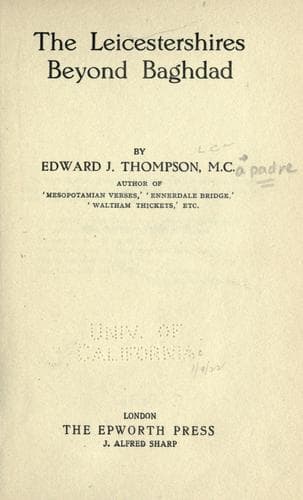
The Leicestershires beyond BaghdadThompson, Edward John
History
The Leicestershires beyond Baghdad
Thompson, Edward John
World War, 1914-1918 -- Campaigns -- Iraq
With the first line was my friend Private W----. As we pushed forward
he looked up, as his custom was, for a 'message.' Perchance, with so
many fears and hopes stirring, there was some buzzing along the
heavenly wires; but the only word he could get was this one, 'Because.'
He puzzled upon it, till the whole flashed on his brain--'Because Thy
lovingkindness is better than life, my lips shall praise Thee.'
Thenceforward he went his ways content; neither can any man have
gathered greater pleasure from the beauty of the morning and those
unwonted flowers than this Plymouth Brother, a gardener by profession,
and, as I found in later days, amid the rich deep meadows of the Holy
Land, a passionate lover of all wild plants.
The left flank was guarded by one section of machine-gunners and one
section of the 32nd Lancers. Next to them moved the Leicestershires.
Some time after 8 a.m. rifle-fire on our left told us that the Cherub's
scouts were in touch with enemy patrols. About 9.30 the first shell
came, our advanced guard being some five thousand yards from Beled
Station.
There were frequent halts, while our few cavalry reconnoitred. Then we
passed into a deep broad nulla between two ancient earth-walls. All
this terrain had been a network of canals and cultivation. Shrapnel was
bursting in our front. We filed out, at the left, on to a plain. Half a
mile ahead was the nearer curve of a hilly ground. The main range ran
in a Carpathian-like sweep across our front, from west to east; turned,
and went across our front again. Beyond this was Beled Station, lying
at the point of a wide fork of hills, the left prong a good mile away,
but the right bending almost up to it. From the forking to the station
was a broken plain of two thousand yards. This plain had to be
overcome, with such assistance as the hills gave. The hills were pretty
uniform in height, and nowhere above thirty feet. The railway cut
directly through the main range, giving the enemy a field of fire for
his machine-guns. The range, with its double fold across our front,
gave the artillery cover, and enabled us to conceal the smallness of
our force; and on both sides of the station it broke into a wilderness
of little knobs and hollows, by which we might creep up.
The shrapnel was uncomfortably close as we crossed to the first sweep
of hilly ground. But it was bursting high, and no casualties occurred.
We halted behind the hills, and the artillery left their wagons, taking
their guns into position where the range curved north-westerly. Here
two four-gun batteries put up a slow and not heavy bombardment on the
station. We waited and watched the shrapnel bursting five hundred yards
to our right. About noon the Leicestershires were ordered to support
the 53rd and 51st Sikhs in an attack on the station. (The 56th Rifles
were in reserve throughout the action.) D Company was to move on the
left of the railway as a flank-guard, and went forward under Captain
Creagh.
Public-domain text, read in full here on John Shaqi.
Reviews
Reviews
No reviews yet
Be the first to share your thoughts on this work.
Join the Discussion
Join the discussion
Sign in to leave a comment or review.
Sign InorCreate an account