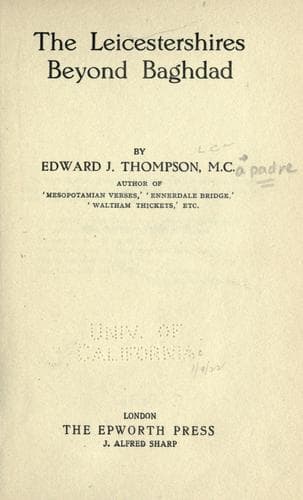
The Leicestershires beyond BaghdadThompson, Edward John
History
The Leicestershires beyond Baghdad
Thompson, Edward John
World War, 1914-1918 -- Campaigns -- Iraq
Meanwhile D Company found the hills on our left strongly held. Every
slope was sown with shallow trenches, earth-scars which held six or
seven Turks, and snipers caused us casualties. Lieutenant-Colonel
Knatchbull, learning this, on his own initiative swung round B and C
Companies across the railway to support D. Wilson now came upon his
first casualty, a signaller hit in the spine. We bandaged him, and left
him in a shallow nulla, sheltered from the bullets flying over. He died
next day.
B and C Companies, crossing the railway, pushed up a long narrow nulla
to the hills where D were engaged. Service's machine-guns put up a
covering fire.
The attack had now developed along two distinct lines, and on the
railway itself we had no troops. The enemy presently put down a barrage
of shrapnel all the right length of the line, where he had seen our men
cross, of which barrage every shell during two hours was wasted. As
Wilson dropped down the embankment on our left side of the railway, we
found machine-gunners sheltering in a quarry, awaiting orders. 'It's
unhealthy over there,' said their O.C., Lieutenant Sanderson. 'The
Turks have a machine-gun on it.' However, there was a lull as we
crossed to the nulla, and only a very few bullets went by. In the nulla
Wilson set up his aid-post, sticking a second flag above the railway,
for the solitary company that was supporting the Sikhs' attack. Wounded
began to come in, the first cases being not bad ones. 'Give you five
rupees for that wound, sergeant,' said Mester Dobson. 'You can't have
it for seventy-five,' said Sergeant Hayes, as he limped off in search
of the ambulances, smiling happily. Perhaps nothing will stir the
unborn generations to greater pity than this knowledge, that for youth
in our generation wounds and bodily hurt were a luxury.
But cases soon came in of men badly hit, in much pain. With them was
borne a dead man, Sergeant Lawrence, D.C.M., a quiet and much-liked
man. My Plymouth Brother friend came also, and sat aside, saying he
could wait, as a stretcher-case was following him. As the doctor saw to
that broken body, my friend rested his wounded leg, and we had some
talk. The long marches, the nights of little sleep, and the unsheltered
days of heat and toil and wearied waiting for evening had tired him
out. 'I want rest,' he said, 'and I think the Lord knows it, and has
sent rest along.' All our men were brave and cheerful, but no more
cheerful hero limped off through the bullets than my calm and gentle
friend.
Wilson went out for a few minutes to see a man in the second line, hit
in the groin. When he returned we had some cruelly broken cases in,
and that nulla saw a deal of pain, and grew stale with the smell of
blood. A fair number of bullets flew over, and there was the occasional
swish of a machine-gun. Mules were killed far back in the second line,
and men hit. But the nulla was safe. The misguided Turk shelled and
machine-gunned the empty space beyond the railway.
Public-domain text, read in full here on John Shaqi.
Reviews
Reviews
No reviews yet
Be the first to share your thoughts on this work.
Join the Discussion
Join the discussion
Sign in to leave a comment or review.
Sign InorCreate an account