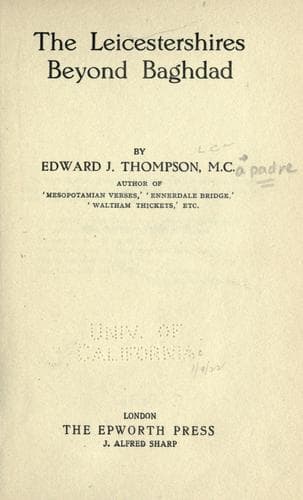
The Leicestershires beyond BaghdadThompson, Edward John
History
The Leicestershires beyond Baghdad
Thompson, Edward John
World War, 1914-1918 -- Campaigns -- Iraq
The Turkish gunners now concentrated on the station and its approaches.
Our cavalry rode through the Leicestershires' lines as those warriors
moved up to an advanced line of defence. They brought a wounded
prisoner. The enemy instantly shrapnelled them, and they scattered,
the prisoner, for all his broken leg, keeping his seat excellently and
riding surprisingly fast. Luck had been with the battalion this day,
and it now remained with them. Many had rifles hit. Fowke, who was a
magnet for bullets, had his right shoulder's star flattened. But there
were no casualties. The enemy, growing vindictive, chased small bodies
of even three or four with shrapnel. He continued to pelt the station,
throwing at least two hundred rounds on it in two hours. Mules and
horses were hit, and many men. Isolated men, holding horses in the
open, had a bad time. Several shells landed on the roof, and had there
been against us the huge guns of other fronts the station would have
gone up in dust. When I saw it again, a month later, I realized what a
rough house that tiny spot had experienced. Unexploded shells were
still in the walls, and on the inner wall of the side that had
sheltered me I counted over twenty direct hits. Fortunately the 5.9's
were not in action this day, and every station on the Baghdad-Samarra
line has been built as a fortress, massively. By incredible luck no
shell came through the doorless openings and rooms behind us; they
struck the inner wall and roof. But the water-station behind us gave
very poor shelter to the men there. Shells burst on the railway, and
sent a sheet of smoke and rubble before them. Two of our guns came up
to the hills that had covered the Sikhs' advance, but fired very few
shells, failing to find a target. The enemy saw their flashes, and
fired back without effect. Then Fritz came and hovered above our
huddled crowd with low, deliberate circles. We took it for granted he
would bomb us, or, at kindest, spot for his guns. But he just hung
over us, and then went to look for our batteries.
Before this McLeod offered me a cup of tea. We drank it in a tin shed a
few yards south of the station. I wanted the tea horribly, but felt it
was 'hairrdly safe to be aboot.' This feeling was shared, for when the
staff-captain and signalling-officer joined us, the latter asked,
'Isn't this spot a bit unhealthy, sir?' 'Oh, no,' said McLeod. 'It's
quite safe from splinters, and it's no use bothering about a direct
hit.' As I had seen high explosive burst pretty well all round, and
both windows were smashed of every inch of glass, I could not quite
share this confidence that the hut was splinter-proof. But I required
that tea. It was very good tea. Had it been shaving water, it would
have gone cold at once. But being tea which I wished to drink quickly,
it remained at boiling-point and declined to be mollified with milk.
However, no more H.E.[3] came our way, only shrapnel.
Public-domain text, read in full here on John Shaqi.
Reviews
Reviews
No reviews yet
Be the first to share your thoughts on this work.
Join the Discussion
Join the discussion
Sign in to leave a comment or review.
Sign InorCreate an account