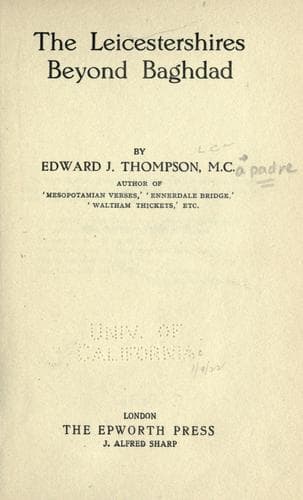
The Leicestershires beyond BaghdadThompson, Edward John
History
The Leicestershires beyond Baghdad
Thompson, Edward John
World War, 1914-1918 -- Campaigns -- Iraq
From first to last nothing moved deeper anger than their constant
exhumation of our dead, and murder, for robbery's sake, of the wounded
or isolated. Major Harley, A.P.M. of Baghdad in later days, learnt to
admire the ability of the Arabs, whose brief Golden Age, when Abbasids
ruled, so far outshone contemporary Europe. When he pressed them on
their ghoul-like ways, they replied, 'You British are so foolish. You
bury the dead with the clothes. The dead do not need clothes, and we
do.' The logic of this does not carry far. To them, as Mussulmans,
graves were sacrosanct to a unique degree; a suspicion of disrespect on
our part would rouse the whole of Islam to flaming wrath. They were
criminals, by their own _ethos_, when they desecrated our dead.
Moreover, they murdered whenever they could, in the cruellest and
beastliest fashion. The marvel is, our actions of reprisal were so
rare. Apart from this of the Cherub's, only two came within my personal
knowledge. Of these two cases, one I and nearly the whole division
considered savage and unjustifiable, which was also the official view.
It was the act of a very young subaltern, mistakenly interpreting an
order. In the other case an Arab was caught red-handed, lurking in a
ditch on our line of march, with one of their loaded knobkerries for
any straggler. I do not know what happened, but have no doubt that he
was shot.
It cannot be said that they acted for patriotic motives, as the Spanish
guerrillas against Napoleon's troops. I remember an article[5] by Sir
William Willcocks dealing with his experiences before the war, in which
he tells how he and a friend went ashore from a steamer on the Tigris.
An Arab calmly dropped on one knee and took aim at the Englishmen, as
if the latter were gazelles or partridges. He missed, and they followed
him into his village, where they asked him why he had fired. The man
answered that he did it in self-defence, for the others had fired
first. 'That,' said the Englishmen, 'is impossible, for you see we are
unarmed.' Hearing this, the village rushed on them and robbed them of
their valuables. Yet one of them was an official high in Government
service.
The other side of the shield, as it affected Brother Buddu, was shown
next day at Harbe. At dawn three men and four women were found in the
middle of the 19th Brigade's camp, outside General Peebles' tent,
wailing. The women said their husbands had been bayoneted and mutilated
by Turks a fortnight before, and buried here. This story proved true.
The women dug up and bore off the decomposing fragments for decent
burial.
The Buddu was an alien in his own land, loathed and oppressed by the
Turk. In his turn he robbed and slew as chance offered. He pursued the
chase for the pelt, and went after human life as our more civilized
race go after buck.
Public-domain text, read in full here on John Shaqi.
Reviews
Reviews
No reviews yet
Be the first to share your thoughts on this work.
Join the Discussion
Join the discussion
Sign in to leave a comment or review.
Sign InorCreate an account