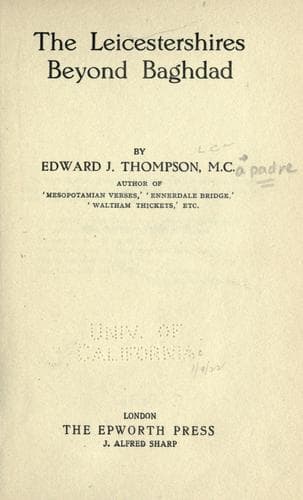
The Leicestershires beyond BaghdadThompson, Edward John
History
The Leicestershires beyond Baghdad
Thompson, Edward John
World War, 1914-1918 -- Campaigns -- Iraq
The two actions which it is customary to call the two Battles of
Istabulat were fought in positions some miles apart. The title of
Istabulat, or of Dujail River, may fitly be reserved for the first
action. The action of the 22nd may then be known as that of Istabulat
Mounds. The Istabulat fight was one in which my own Brigade were
spectators, except for isolated and piece-meal action. We were in
reserve; and the 8th Brigade, of the 3rd Division, were in support, in
line with us, and behind the Median Wall. The enemy were trying a new
bowler, Shefket Pasha being in command, vice Kazim Karabekir Bey, who
had resigned from command of their Eighteenth Corps just before Baghdad
fell. We should not have supposed that this made any difference, even
had we known.
The Istabulat battle has been described in print,[9] though
inadequately and, in one important respect, most unfairly. That
unfairness I shall correct in the next chapter. But for this first
action I do not propose to do more than give an outline of the work of
the two Brigades engaged, and an account of our own part in reserve.
The enemy's position was of immense strength. Old mounds made an
upraised plateau, through which the Dujail Canal ran swiftly between
steep and lofty banks. The 19th and 21st Brigades attacked in
converging columns, the first thrusting right in, the second coming
with an arm sweep round. Thus, both frontal and flank attacks were
provided. The enemy's position was so strong, his redoubts so lofty,
and the whole formidable terrain had been so entrenched and wired round
that I do not believe we hoped to do more than eat our way into a part
of his line. The operation was magnificent bluff. His morale was
calculated to be now so low that he was likely to evacuate the position
if we bit deeply into it. If this view is correct, General Maude was
taking a heavy risk. But he not only always made all preparation
possible before he struck, but on occasion did not hesitate to strike
where the odds should have been against success, but the prize of
success was great, and the morale of the troops against him weakened by
repeated blows. In the Jebel Hamrin his calculation failed. But at
Istabulat it succeeded. But, had the Turk been as he was in Sannaiyat
days, two months back, we should have had a week of dreadful fighting
instead of one bloody day. Holding Istabulat heights was a force
estimated at seven thousand four hundred infantry and five hundred
sabres, with thirty-two guns. This force, in its perfect position, we
attacked with two weak brigades.
Public-domain text, read in full here on John Shaqi.
Reviews
Reviews
No reviews yet
Be the first to share your thoughts on this work.
Join the Discussion
Join the discussion
Sign in to leave a comment or review.
Sign InorCreate an account