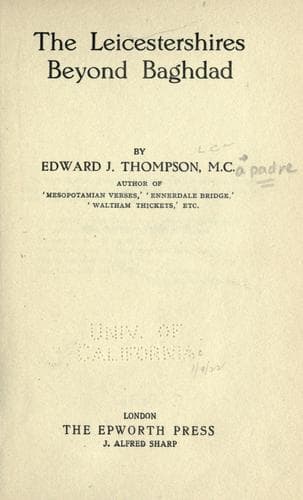
The Leicestershires beyond BaghdadThompson, Edward John
History
The Leicestershires beyond Baghdad
Thompson, Edward John
World War, 1914-1918 -- Campaigns -- Iraq
Voyaging through strange fields of thought alone.
The reader will be weary of _Henry V._ Nevertheless Shakespeare came to
the aid of us, his countrymen, again as gallant old Fowke quoted from
the heart and brain of England:
He which hath no stomach to this fight,
Let him depart....
We would not die in that man's company,
That fears his fellowship to die with us.
So laughter ended a terrible day. Next day our tiny band was the
spearhead of a handful of fifteen hundred bayonets, who caught the Turk
in his fastnesses, wrested guns and prisoners from him, and slew and
broke his forces so that they recoiled for thirty miles.
There was no rest. Through the darkness J.Y. flitted to and fro, and
here and there a spectral blaze flickered furtively. We had neither
blankets nor greatcoats, for fear of shell-fire made it impossible to
bring the carts up. The night was infernal with cold; sand-flies rose
in myriads from the ground; we shivered and itched in our shorts. Old
aches and pains found me out, rheumatism and troubles of a tropical
climate. I lay between two men, both of whom had seen their last
sunset; one was Sergeant-Major Whatsize. Infinitely far off seemed
peace and the time, as Grant-Anderson expressed it,
When the Gurkhas cease from gurkhing, and the Sikhs are sick no
more.
At midnight came a roar, then a crashing. It was Johnny blowing up
Istabulat Station. At three o'clock we were aroused.
FOOTNOTES:
[7] _Anabasis_, Book ii.
[8] The Divisional Heads of Ordnance and Supply and Transport.
[9] 'The Battle that Won Samarrah,' by Brigadier-General A.G. Wauchope,
C.M.G., D.S.O.; _Blackwood's_, April, 1918.
[10] The Leicestershires' badge is a tiger, commemorating service in
India a century ago.
[11] Gun-shot.
IV
THE BATTLE FOR SAMARRA
Salute the sacred dead,
Who went and who return not.
J.R. LOWELL.
Day was welcome, for it brought movement, though movement harassed by
cold and then by heat and ever-increasing clouds of flies. We snatched
our mugs of tea, our bread and bacon. At 3.30 we moved off. We marched
behind the wall, then crossed the Dujail, and pushed towards the left
flank of the enemy's position. Vast clouds of white dust shut us close
from any knowledge as we climbed up a narrow pass. Fortunately the
light was hardly even dim yet.
We dropped into a plain, and saw the Hero's Way by which the others had
gone. Dead Gurkhas and Highlanders lay everywhere. I have always felt
that the sight of a dead Highlander touches even deeper springs of
pathos than the sight of any other corpse. Analysed, the feeling comes
to this, I think: in his kilt he seems so obviously a peasant, lying
murdered on the breast of the Universal Mother.
Public-domain text, read in full here on John Shaqi.
Reviews
Reviews
No reviews yet
Be the first to share your thoughts on this work.
Join the Discussion
Join the discussion
Sign in to leave a comment or review.
Sign InorCreate an account