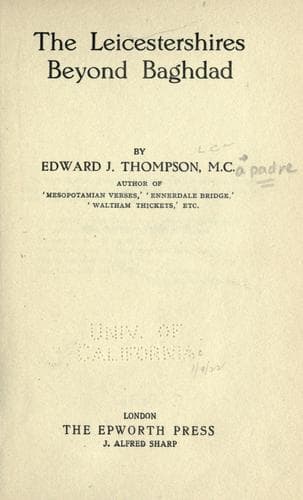
The Leicestershires beyond BaghdadThompson, Edward John
History
The Leicestershires beyond Baghdad
Thompson, Edward John
World War, 1914-1918 -- Campaigns -- Iraq
Dropping bullets took toll even before we left the mounds. As I came up
to join Wilson a man was carried past. It was Major Adams, acting
second-in-command of the 53rd Sikhs. He had gone ahead of his battalion
to the wall, where a bullet struck him in the forehead. He died within
fifteen minutes, and was unconscious as he went past me. No man in the
brigade was more beloved. He was always first to offer hospitality. It
was he who met our mess when they first reached Sumaikchah and invited
them to come to his own for lunch. I never saw him but with a smile of
infinite kindliness on his face, and I saw him very often.
Face swift to welcome, kindling eyes whose light
Saw all as friends, we shall not meet again!
Here in the aid-post sat the Cherub, struck at last, a flesh-wound in
his thigh; with many others. Next to him was Charles Copeman,
unwounded, waiting to go forward with his bombers. Presently came
Warren, bright and jaunty as a bird, and carrying his left arm. 'I'm
all right,' said Montag, 'got a cushy one here.' On his heels came
G.A.; his face was that of a man fresh from the Beatific Vision. Much
later, when I had managed to get transport to push him away, I asked
him, 'Got your stick, G.A.?' This was a stout stave on which he had
carved, patiently and skilfully, his name, 'H.T. Grant-Anderson,' and a
fierce and able-looking tiger at the top, then his regiment, then
curving round it the names of the actions in which it had supported
him: _Sannaiyat_, _Iron Bridge_, _Mushaidie_, _Beled Station_; while
down the line now he was to add _Istabulat-Samarra_. This famed work of
art he flaunted triumphantly as he climbed into the ambulance.
But with these, and before some of them, came very heavy news. By that
fatal wall and on the bullet-swept space before it died many of our
bravest. Hall, M.C., aged nineteen, who looked like Kipling's Afridi:
He trod the ling like a buck in spring, and he looked like a
lance in rest;
Hall fell, facing the finish of our journey and those bright domes of
Samarra, already gilded from the sloping sun. His death was merciful, a
bullet through the heart; 'and sorrow came, not to him, but to those
who loved him.'
The theory was strongly held in the Leicestershires that the only way
was to advance steadily. This weakened the enemy's morale, and,
further, he had no chance to pick out his ranges accurately. To this
theory and practice of theirs they put down the fact that, though in
the forefront of all their battles, their losses were often so much
slighter than those of units that had acted more cautiously. I quote
again from Hasted's brilliant lecture on the battle:
Public-domain text, read in full here on John Shaqi.
Reviews
Reviews
No reviews yet
Be the first to share your thoughts on this work.
Join the Discussion
Join the discussion
Sign in to leave a comment or review.
Sign InorCreate an account