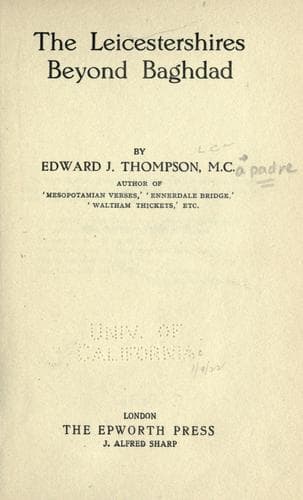
The Leicestershires beyond BaghdadThompson, Edward John
History
The Leicestershires beyond Baghdad
Thompson, Edward John
World War, 1914-1918 -- Campaigns -- Iraq
At dusk Wilson came. He had been toiling away, exposed and close up to
the fighters, as always--there never was a braver regimental medical
officer--and he now asked me to be responsible for getting his wounded
away, whilst he searched the battlefield. So all his cases were
evacuated into my place. At the same time many chits reached me,
addressed to the O.C. Clearing-Station. As there was no such person, I
opened these. The regimental aid-posts were pressing to be cleared. My
own place had men from seven different regiments, British and Indian,
as well as Turks, and Wilson was sending more along. So I found McLeod,
and we 'phoned down to the field ambulances. These were congested from
yesterday's battle and to-day's walking cases, and replied that nothing
could be done till dawn. But we were so insistent that about midnight
bullock-carts turned up, and I got fifty wounded away. The
'cahars,'[17] in their zeal to remove all kit belonging to the wounded,
carried off my water-bottle, haversack, rations, and communion-kit. But
before this I had been down to the Tigris in the darkness, and drunk
like a wounded wolf.
To return to the battle as it died away. The Forward Observing Officer
with the Leicestershires sent word back that fourteen guns (instead of
nine) had been taken. The news was exultantly forwarded to Corps H.Q.
When the case proved to be nine only, and those nine lost again, the
message was allowed to stand, the authorities hoping against hope that
the guns would walk back into our possession. And Fortune was very good
to them. Those guns, indeed, came not back; but, as darkness fell, two
burning barges, as already mentioned, floated down the river. One was
exploding, like a magazine on fire. This contained ammunition. The
other barge, when pulled to shore, was found to contain fourteen
field-guns, the number specified to Corps--old guns, but serviceable.
Johnny, despairing of getting these away, had set fire to the barge to
sink them. So the original message stood, and our loss could be glossed
over. And the wastefulness of sinking quite good guns was avoided.
The night was sleepless, bitterly cold. Dobson and I kept a watch for
Arabs. I sat beside a dead man, and shared his oil-sheet. A few more
wounded came in after midnight, among them Sergeant Tivey. All night
long wounded Turks crawled the battlefields and cried in the cold. But
I heard none of them, for there were groans much nearer. Our unwounded
prisoners were crowded into a nulla. Among them was the Turkish
Artillery Brigade Commander, who knew some English and kept insisting
on a hearing from time to time. But all he ever said was, 'Yes,
gentlemen, you have got my guns, but, what is far worse, you have got
me.' Had we cared, we might have cheered him with the information that
we had not got his guns, but only himself. Yet, considering the
relative value, in his eyes, of himself and these, such information
would hardly have consoled him.
Public-domain text, read in full here on John Shaqi.
Reviews
Reviews
No reviews yet
Be the first to share your thoughts on this work.
Join the Discussion
Join the discussion
Sign in to leave a comment or review.
Sign InorCreate an account