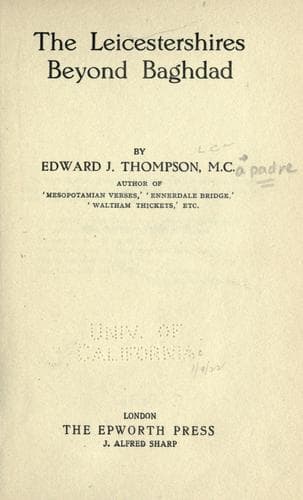
The Leicestershires beyond BaghdadThompson, Edward John
History
The Leicestershires beyond Baghdad
Thompson, Edward John
World War, 1914-1918 -- Campaigns -- Iraq
This book deals first with the April campaign as it affected the right
bank of the Tigris. Between Baghdad and Samarra was a stretch of eighty
miles of railroad, the only completed portion, south of Mosul, of the
Berlin-Baghdad Railway. If we could capture this the Turk would have to
supply his troops from Mosul by the treacherous and shallow Tigris. The
Samarra fighting, these railhead battles, was the last organized
campaign which the Turk fought. Our First Corps, consisting of two
Indian divisions, the 3rd and the 7th, operated against railhead; while
the Third Corps, consisting of the 13th Division, the only all-British
division in Mesopotamia, and the 14th Indian Division, fought their way
up the left bank.
After Samarra fell the Turk could do nothing but collect small bodies
of troops, which we attacked in detail, usually with success, and
throughout 1918, after Tekrit, always attacked with complete success
(as we did at Ramadie in September, 1917, destroying the whole force).
Ramadie, on the Euphrates, and Tekrit, on the Tigris, were the first of
the campaigns of this last phase of the Mesopotamian War, campaigns
that were glorified raids. At the time of Tekrit, General Allenby
settled for the Turk, once for all, the choice between Palestine and
Mesopotamia.
Our Tekrit campaign was a sympathetic attack, concurrent with Allenby's
great Gaza offensive. This campaign is the theme of the second portion
of this book.
I
BELED
Red of gladiolus glimmering through the wheat--
Red flower of Valour springing at our feet!
Dark-flowered hyacinth mingling with the red--
Dark flower of Patience on the way we tread!
Scarlet of poppy waving o'er the grass--
Honour's bright flags along the road we pass!
Thorns that torment, and grassy spikes that fret,
Thistles that all the fiery way beset!
These shall be theirs, when Duty's day is sped;
They shall lie down, the living and the dead.
1. THE WAY TO BELED
Baghdad fell on March 11, 1917. The soldier's joy was deepened by the
belief that here his warfare was accomplished, his marching finished.
Even when we went by the city, and fought battles on either bank, the
7th Indian Division at Mushaidiyeh (March 14) and the 3rd Indian, most
disastrously, in the foothills of the Jebel Hamrin (March 25), this
comfort was not destroyed. These two hard actions were but the sweeping
away of ants' nests from before a house; our position now secured, we
should fall back, and rest in Baghdad. The Turk might try to turn us
out; but that was a very different affair, and it would be months
before he could even dream of an offensive.
So in April the 7th Division had withdrawn to Baghdad, all except the
28th Brigade, who were at Babi, a dozen miles up-stream. At Babi it was
not yet desert--there was grass and wheat; but the garden-belt and
trees had finished.
Public-domain text, read in full here on John Shaqi.
Reviews
Reviews
No reviews yet
Be the first to share your thoughts on this work.
Join the Discussion
Join the discussion
Sign in to leave a comment or review.
Sign InorCreate an account