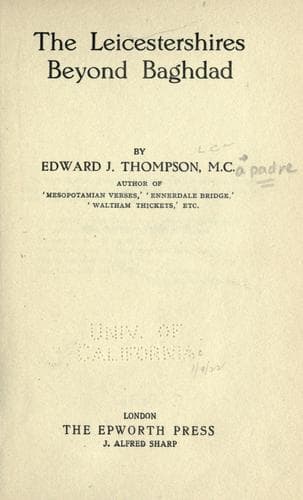
The Leicestershires beyond BaghdadThompson, Edward John
History
The Leicestershires beyond Baghdad
Thompson, Edward John
World War, 1914-1918 -- Campaigns -- Iraq
Tekrit was one of the Turk's best battles in the class of which he is
such a master, the rearguard action. Our airmen reported that, from our
arrival, his troops and transport were flowing away steadily. His lines
were held by artillery and machine-guns, fearlessly worked to the last
minute of safety. Our cavalry operated on the left. It was here the
action broke down. At this point there was only one line of trenches
against us, and many think the 28th Brigade should have been sent in.
Had this been done, the enemy right would have been forced back, and
his troops pinned to the river, with large captures of men and guns as
result. But the 28th Brigade were kept out, because of a cavalry
mistake. The latter's orders were to drop one brigade on the flank, and
then push through to the river, behind the enemy. Then the 28th Brigade
were to go in, and, when they had cleared the Turks out of their
entrenchments, the cavalry were to collect the prisoners. But, instead,
the cavalry, after dropping a brigade to watch the flank, waited, and
finally did a very gallant but useless charge.
The terrain was extremely difficult. Almost the first thing the
assaulting forces had to do was to cross a nulla sixty feet deep and a
quarter of a mile wide, commanded by machine-guns, and searched with
shrapnel. Later, when my own brigade moved up in support, we crossed
this nulla. The toilsome going over slipping shingle was like Satan's
painful steps on the burning marl,
not like those steps
On Heaven's azure, and the torrid clime
Smote on him sore besides, vaulted with fire.
The story of this day belongs to the 8th and 19th Brigades. My own were
spectators only; deeply interested, and our own fate might at any
moment become involved, but harassed with heat and flies and the
unspeakable boredom born of long warfare, which even a battle can
disperse only in part. Stories filtered through of the heroic work of
the Seaforths and Manchesters and of the 47th and 59th Sikhs. Report
persisted that the Seaforths' head quarters had been knocked out by a
direct hit, with twelve casualties, and that their regimental
sergeant-major (Sutherland) was killed. This rumour was partly true,
but a little exaggerated. Their colonel (Reginald Schomberg) was
wounded, and their adjutant (McRae). This was the McRae who had fought
the Turks with his naked fists at Sheikh Saad in January, 1916, and who
rose from sergeant-major to Lieutenant-Colonel, with D.S.O. and Bar.
Sutherland was not killed, but wounded. Lee, the Seaforths' padre, kept
up the tradition set by Dr. Ewing, that 'unsubduable old Roman' whose
white locks had waved through so many battles, till he was wounded at
the forcing of Baghdad. Burn, the one Seaforths' officer killed, out of
twelve hit, was struck close behind Lee. Milne and Baldry were killed
among the Manchesters' officers.
Public-domain text, read in full here on John Shaqi.
Reviews
Reviews
No reviews yet
Be the first to share your thoughts on this work.
Elsewhere in the archive
Join the Discussion
Join the discussion
Sign in to leave a comment or review.
Sign InorCreate an account