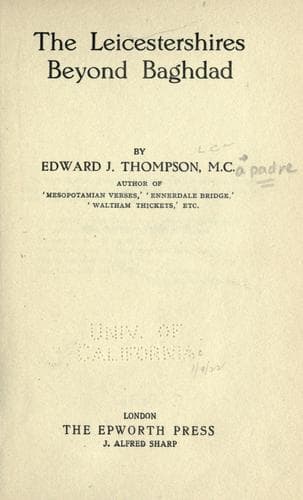
The Leicestershires beyond BaghdadThompson, Edward John
History
The Leicestershires beyond Baghdad
Thompson, Edward John
World War, 1914-1918 -- Campaigns -- Iraq
From 10.30 to 11 a.m. was a time of artillery preparation. Fritz
drifted restlessly about; our own planes were busy; klaxons sounded;
messages were dropped. According to information, opposite us the
Turkish 51st and 52nd Divisions were unsupported. Both were old foes of
Sannaiyat days. By 11.30 the enemy's first two lines were taken by
direct assault. At 3 p.m. my own brigade moved two miles closer in, on
the left. It was a costly business, pushing the enemy back by frontal
attack just where he was strongest in every way. Long lines of our
wounded passed us, with a few Turkish prisoners. The day was as
intolerably hot as the night had been cold. By four o'clock the Turk
had got most of his heavier guns back. We were shelling a small
mosque, which he was using as an O.P. The 6-inches registered a hit,
which sent up a white cloud of dust and powder. Every one was hopeful.
The cavalry and 'lambs' were said to be right round the enemy's flank,
and some thousands of prisoners were regarded as certain. Captain
Henderson, the Diggins of the Manchesters, was rumoured to have taken
three guns. At 4.30 the 21st Brigade launched an effective enfilade on
the enemy's transport from across the river; the two attacking brigades
went in again; the cavalry charged across the Turks' right trenches. We
of the 28th could watch it all with the naked eye, the one confusion
being sometimes as to whether it was Turks scurrying away or Seaforths
going in. But we saw the Seaforths' magnificent charge. Unfortunately
most of the crumps which we took to be among a Turkish counter-attack
were among our own men, who at one time ran into their own barrage.
Their line swept forward, irresistible as always. In later days, in
Palestine, when a despatch praised various miscellaneous troops who had
been in their first actions and done not too badly, some one was
foolish enough to express surprise that the Seaforths were not
mentioned by name. 'I should consider it an insult,' said their
colonel, 'if any one thought it worth mentioning that my regiment had
done what they were told to do. We take some things for granted.' At
Tekrit Schomberg, though already wounded, led his men in person. He was
scholar and Christian; 'the bravest of the brave,' yet a lover of all
fair things.
As the Turks ran from their trenches our machine-guns cut them up.
Rumour now grew positive that we had the enemy hemmed against the
river. Evening closed with a deal of desultory gunfire, which continued
spasmodically all night. My brigade went to rest, in anticipation of a
renewal of battle next dawn, when our turn would be due. The ambulances
had worked nobly all day, cars sweeping up to well within shell-range;
and all night long stretcher-bearer parties were busy. Their work was
superintended by Captain Godson, whose M.C. was well earned.
Tekrit cost us about two thousand casualties. Many of the wounded
collected in the 19 C.C.S.[30] at Samarra had been wounded by aeroplane
bombs.
Public-domain text, read in full here on John Shaqi.
Reviews
Reviews
No reviews yet
Be the first to share your thoughts on this work.
Elsewhere in the archive
Join the Discussion
Join the discussion
Sign in to leave a comment or review.
Sign InorCreate an account