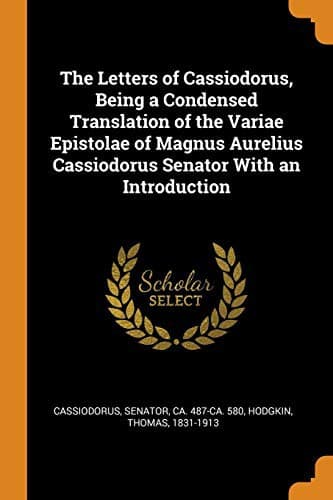
The Letters of Cassiodorus: Being a Condensed Translation of the Variae Epistolae of Magnus Aurelius Cassiodorus SenatorCassiodorus, Senator
History
The Letters of Cassiodorus: Being a Condensed Translation of the Variae Epistolae of Magnus Aurelius Cassiodorus Senator
Cassiodorus, Senator
Goths -- Italy; Italy -- History -- 476-1268
[Odovacar was buried [Greek: en lithine larnaki] (Joann. Ant. fr.
214). The great stone coffins of Honorius and Valentinian will be
remembered by every visitor to Ravenna.]
20. KING THEODORIC TO THE SAJO GRIMODA AND TO THE APPARITOR
FERROCINCTUS.
[Sidenote: Oppression of Castorius by Faustus.]
[Cf. Dahn, 'Koenige der Germanen' iii. 86 and 113.]
'We are determined to assist the humble, and to repress the violence
of the proud.
'The lamentable petition of Castorius sets forth that he has been
unjustly deprived of his property by the magnificent Praetorian
Praefect Faustus. [The same, no doubt, to whom are addressed iii. 55,
i. 35, and the immediately succeeding letter (iii. 21).]
'If it be so, let the invader (pervasor) restore to Castorius his
property, and hand over, besides, another property of equal value.
'If Faustus have employed any intermediate person in the act of
violence, let him be brought to us in chains; and if that well-known
author of ill [Faustus] tries any further to injure Castorius, he
shall pay L2,000, besides having the misery of seeing his would-be
victim unharmed.
'No Powers of any kind, be they Praetorian Praefects or what they may,
shall be permitted to trample on the lowly.'
21. KING THEODORIC TO FAUSTUS, VIR ILLUSTRIS.
[Sidenote: Disgrace and temporary exile of Faustus.]
'As all men require change, Faustus is allowed to absent himself from
the sacred walls of Rome for four months, which he may spend at his
own Penates. The King expects, however, that he will then return to
the most famous (opinatissima) City, from which no Roman Senator can
long be absent without grief.'
[Coupling this letter with its immediate predecessor it is difficult
not to believe that Faustus is sent away in disgrace--notwithstanding
the smooth words here used--for the act of injustice therein
mentioned.
But why is he only addressed as Vir Illustris, and not also as
Praefectus? Perhaps his term of office was expired; perhaps he was
even dismissed from it.]
22. KING THEODORIC TO ARTEMIDORUS, VIR ILLUSTRIS.
[Sidenote: An earnest invitation to the King's friend, Artemidorus.]
'We hereby [by these oracles] invite your Greatness to behold us,
which we know will be most agreeable to you, in order that you who
have now spent a large portion of your life with us may be satisfied
by the sweetness of our presence. He who is permitted to share our
converse deems it a Divine boon. We believe that you will come gladly,
as we shall entertain you with alacrity.'
[Cf. Dahn iii. 283-4. The ending of the letter (Venire te gaudentem
credimus, quem alacriter sustinemus) is the common form, and
'sustineo' is a technical word for the King's reception of his
subjects: see iii. 28, ad finem.]
23. KING THEODORIC TO COLOSSAEUS, VIR ILLUSTRIS AND COMES (CIR. A.D.
505).
[Sidenote: Appointment of Colossaeus as Governor of Pannonia.]
'We delight to entrust our mandates to persons of approved character.
Public-domain text, read in full here on John Shaqi.
Reviews
Reviews
No reviews yet
Be the first to share your thoughts on this work.
Elsewhere in the archive
Join the Discussion
Join the discussion
Sign in to leave a comment or review.
Sign InorCreate an account