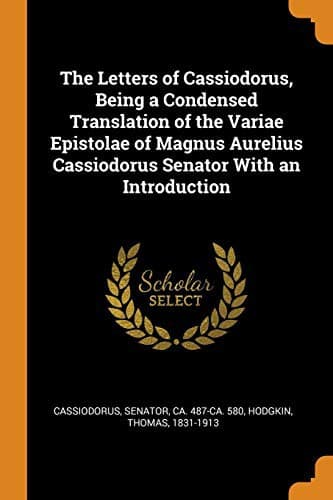
The Letters of Cassiodorus: Being a Condensed Translation of the Variae Epistolae of Magnus Aurelius Cassiodorus SenatorCassiodorus, Senator
History
The Letters of Cassiodorus: Being a Condensed Translation of the Variae Epistolae of Magnus Aurelius Cassiodorus Senator
Cassiodorus, Senator
Goths -- Italy; Italy -- History -- 476-1268
[The description of Tupha as 'proscriptus' makes it probable that we
are dealing with that officer of Odovacar whose double treachery
(489-490) so nearly caused the failure of Theodoric's invasion of
Italy, and who finally fell in battle against his fellow-rebel,
Frederic the Rugian. The only difficulty is the lapse of time since
those events, as this letter was probably written not earlier than
about 511; but that is in some degree met by the word _quondam_ in the
sentence quoted (_n._ 1, p. 250).]
33. KING THEODORIC TO ALL THE JEWS OF GENOA.
[Sidenote: Privileges of the Jews confirmed.]
'The true mark of _civilitas_ is the observance of law. It is this
which makes life in communities possible, and which separates man from
the brutes. We therefore gladly accede to your request that all the
privileges which the foresight of antiquity conferred upon the Jewish
customs shall be renewed to you[349], for in truth it is our great
desire that the laws of the ancients shall be kept in force to secure
the reverence due to us[350]. Everything which has been found to
conduce to _civilitas_ should be held fast with enduring devotion.'
[Footnote 349: 'Privilegia debere servari quae Judaicis institutis
legum provida decrevit antiquitas.']
[Footnote 350: 'Quod nos libenter annuimus qui jura veterum ad nostram
cupimus reverentiam custodiri.']
34. KING THEODORIC TO DUDA THE SAJO.
[Sidenote: Buried treasure to be reclaimed for the State.]
'It is the part of true prudence to recall to the uses of commerce
"the talent hidden in the earth." We therefore direct you, by this
"moderata jussio," where you hear of buried treasures to proceed to
the spot with suitable witnesses and reclaim for the public Treasury
either gold or silver, abstaining, however, from actually laying hands
on the ashes of the dead[351]. The dead can do nothing with treasure,
and it is not greedy to take away what the holder of it can never
mourn the loss of.
[Footnote 351: How this was to be done is not quite clear, since it is
plain that this letter is really and chiefly an order for rifling
_sepulchres_ in search of buried treasure.]
'Eacus is said to have discovered the use of gold, and Indus, King of
the Scythians, that of silver. They are extremely useful metals.'
35. KING THEODORIC TO THE REPRESENTATIVES (ACTORES) OF ALBINUS.
[Sidenote: An extravagant minor. Restitutio in integrum.]
'It has been wisely decided by Antiquity that minors cannot make a
binding contract, for they are naturally the prey of every sharper.
You allege that your _patronus_ [Albinus] is under age, that he is
heaping up expenses instead of property, and that his raw boyhood does
not know what is really for his benefit. If this be correct, and be
legally proved, he is entitled to a _restitutio in integrum_' [a suit
commenced through these Actores for the quashing of the contracts
which have been fraudulently made with the minor].
Public-domain text, read in full here on John Shaqi.
Reviews
Reviews
No reviews yet
Be the first to share your thoughts on this work.
Elsewhere in the archive
Join the Discussion
Join the discussion
Sign in to leave a comment or review.
Sign InorCreate an account