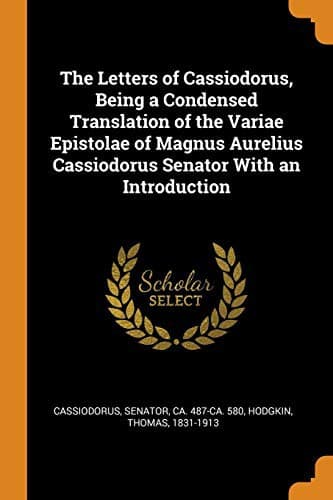
The Letters of Cassiodorus: Being a Condensed Translation of the Variae Epistolae of Magnus Aurelius Cassiodorus SenatorCassiodorus, Senator
History
The Letters of Cassiodorus: Being a Condensed Translation of the Variae Epistolae of Magnus Aurelius Cassiodorus Senator
Cassiodorus, Senator
Goths -- Italy; Italy -- History -- 476-1268
[Footnote 414: 'Et ne cuiquam labor suus videatur ingratus, salaria
eis pro qualitate locatae rei, vestra volumus aequitate constitui.']
'(4) Import duties[415] are to be regularly collected and honestly
paid over.
[Footnote 415: 'Transmarinorum canon.']
'(5) The officers of the mint are not to make their private gains out
of the coinage.'
(6) An obscure sentence as to the 'Canon telonei' [from the Greek
[Greek: telones], a tax-gatherer. Garet reads 'Tolonei,' which is
probably an error].
(7) The same as to the _Actus Laeti_, whose conscience is assailed by
the grossest imputations. [Laetus is perhaps the name of an official.]
'(8) Those concerned in _furtivae actiones_, and their accomplices,
are to disgorge the property thus acquired.
'(9) Those who have received _praebendae_ [apparently official
allowances charged on the Province] are, with detestable injustice,
claiming them _both_ in money and in kind. This must be put a stop to:
of course the one mode of payment is meant to be alternative to the
other.
'(10) The Exactores (Collectors) are said to be extorting from the
Provincials more than they pay into our chamber (_cubiculum_). Let
this be carefully examined into, and let the payment exacted be the
same that was fixed in the times of Alaric and Euric.
'(11) The abuse of claiming extortions (_paraveredi_) by those who
have a right to use the public posts must be repressed.
'(12) The defence of the Provincials by the _Villici_ is so costly,
and seems to be so unpopular, that we remove it altogether.' [For this
_tuitio villici_, see Dahn iii. 131; but he is not able to throw much
light on the nature of the office of the _Villicus_.]
'(13) Degrading services (servitia famulatus) are not to be claimed of
our free-born Goths, although they may be residents in cities[416].'
[Footnote 416: Cf. the 30th letter of this book.]
[This very long letter is one of great importance, but also of great
difficulty.]
40. KING THEODORIC TO CYPRIAN, COUNT OF THE SACRED LARGESSES.
[This Cyprian is the accuser of Albinus and Boethius.]
41. KING THEODORIC TO THE SENATE OF THE CITY OF ROME.
[On Cyprian's appointment to the above office, 524.]
[Sidenote: Promotion of Cyprian to the Comitiva Sacrarum Largitionum.]
The usual pair of letters setting forth the merits of the new
official. The Senate is congratulated on the fact that the King never
presents to a place in that body a mere tyro in official life, but
always himself first tests the servants of the State, and rewards with
a place in the Senate only those who have shown themselves worthy of
it.
Cyprian is the son of a man of merit, Opilio, who in the times of the
State's ill-fortune was chosen to a place in the royal household[417].
He was not able, owing to the wretchedness of the times, to do much
for his son. The difference between the fortunes of father and son is
the measure of the happy change introduced by the rule of Theodoric.
Public-domain text, read in full here on John Shaqi.
Reviews
Reviews
No reviews yet
Be the first to share your thoughts on this work.
Elsewhere in the archive
Join the Discussion
Join the discussion
Sign in to leave a comment or review.
Sign InorCreate an account