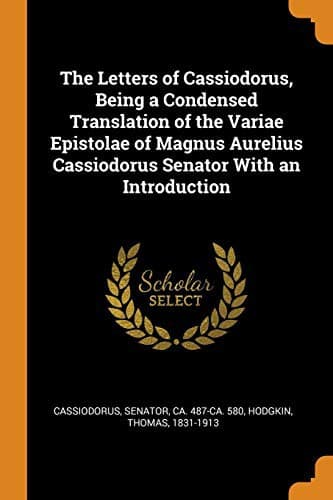
The Letters of Cassiodorus: Being a Condensed Translation of the Variae Epistolae of Magnus Aurelius Cassiodorus SenatorCassiodorus, Senator
History
The Letters of Cassiodorus: Being a Condensed Translation of the Variae Epistolae of Magnus Aurelius Cassiodorus Senator
Cassiodorus, Senator
Goths -- Italy; Italy -- History -- 476-1268
Rehearses the motives of the previous edict, and directs that both it
and the Senatus Consulta having reference to the same subject [and
framed two years previously], be engraved on marble tablets, and fixed
up in a conspicuous place, before the Atrium of St. Peter the Apostle.
17. KING ATHALARIC TO THE SAME (BETWEEN 532 AND 534).
[Sidenote: Release of two Roman citizens accused of sedition.]
'We cannot bear that there should be sadness in Rome, the head of the
world. We hear with regret from the Apostolic Pope John, and other
nobles, that A and B, who are Romans, on a mere suspicion of sedition
are being macerated by so long imprisonment that the whole city mourns
for them; no gladness of a holyday and no respect for the Papal
name[606] (which is most dear to us) availing to mitigate their
confinement. This treatment of persons against whom no crime has been
proved distresses us much, and we admonish your Greatness, wherever
you may succeed in finding them, to set them free. If, confident in
their innocence, they think that they have been unjustly tormented, we
give them liberty to make their appeal to the laws. Judges were
raised to their high estate, not to oppress but to defend the
innocent.
[Footnote 606: 'Nec ulla--quae apud nos est gratissima--nominis sui
dignitas subveniret.' I think _sui_ must refer to the
recently-mentioned _Papa Johannes_.]
'Now let the Romans return to their ancient gladness; nor let them
think that any [rulers] please us but those who seek to act with
fairness and moderation. Let them understand that our forefathers
underwent labours and dangers that _they_ might have rest; and that we
are expending large sums in order that they may rejoice with garrulous
exultation. For even if they have before now suffered some rough and
unjust treatment, let them not believe that that is a thing to be
neglected by our Mildness. No; for we give ourselves no rest, that
they may enjoy secure peace and calm gladness. Let them understand at
once that _we_ cannot love the men whose excesses have made them
terrible to our subjects. Whose favour do those men expect to win who
have earned the dislike of their fellow-citizens? They might have
reaped a harvest of the public love, and instead thereof they have so
acted that their names are justly held in execration.'
18. THE EDICT OF ATHALARIC.
[This edict is minutely examined by Dahn ('Koenige der Germanen' iv.
123-135). I have adopted his division of paragraphs, though rather
disposed to think that the 'De Donationibus' should be broken up into
two, to prevent counting the Epilogue as a section. See also Manso
('Geschichte der Ostrogothen' 405-415).]
[Sidenote: Edict of Athalaric.]
'_Prologue._ This edict is a general one. No names are mentioned in
it, and those who are conscious of innocence need take no offence at
anything contained therein.
Public-domain text, read in full here on John Shaqi.
Reviews
Reviews
No reviews yet
Be the first to share your thoughts on this work.
Elsewhere in the archive
Join the Discussion
Join the discussion
Sign in to leave a comment or review.
Sign InorCreate an account