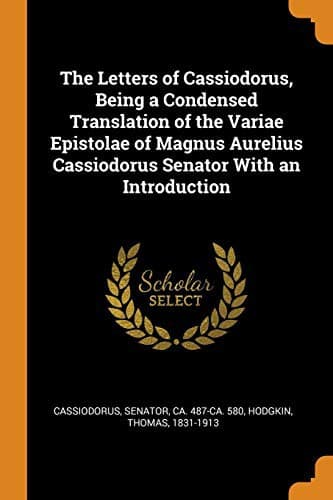
The Letters of Cassiodorus: Being a Condensed Translation of the Variae Epistolae of Magnus Aurelius Cassiodorus SenatorCassiodorus, Senator
History
The Letters of Cassiodorus: Being a Condensed Translation of the Variae Epistolae of Magnus Aurelius Cassiodorus Senator
Cassiodorus, Senator
Goths -- Italy; Italy -- History -- 476-1268
'For long an ominous whisper has reached our ears that certain
persons, despising _civilitas_, affect a life of beastly
barbarism[607], returning to the wild beginnings of society, and
looking with a fierce hatred on all human laws. The present seems to
us a fitting time for repressing these men, in order that we may be
hunting down vice and immorality within the Republic at the same time
that, with God's help, we are resisting her external foes. Both are
hurtful, both have to be repelled; but the internal enemy is even more
dangerous than the external. One, however, rests upon the other; and
we shall more easily sweep down the armies of our enemies if we subdue
under us the vices of the age. [This allusion to foreign enemies is
perhaps explained by the hint in Jordanes ('De Reb. Get.' 59) of
threatened war with the Franks. But he gives us no sufficient
indication of time to enable us to fix the date of the Edictum.]
[Footnote 607: 'Affectare vivere belluina saevitia.']
'I. _Forcible Appropriation of Landed Property_[608] (Pervasio). This
is a crime which is quite inconsistent with _civilitas_, and we remit
those who are guilty of it to the punishment[609] provided by a law of
Divus Valentinianus [Valentinian III. Novell. xix. 'De Invasoribus'],
adding that if anyone is unable to pay the penalty therein provided he
shall suffer banishment (deportatio). He ought to have been more chary
of disobeying the laws if he had no means to pay the penalty. Judges
who shrink from obeying this law, and allow the _Pervasor_ to remain
in possession of what he has forcibly annexed, shall lose their
offices and be held liable to pay to our Treasury the same fine which
might have been exacted from him. If the _Pervasor_ sets the Judge's
official staff (officium) at defiance, on the report of the Judge our
Sajones will make _him_ feel the weight of the royal vengeance who
refused to obey the [humbler] _Cognitor_.
[Footnote 608: 'Praedia urbana vel rustica.']
[Footnote 609: The punishment consisted in loss of all claim to the
property--which was generally seized by someone who had some kind of
ostensible claim to it--and a penalty of equal value with that of the
property wrongfully seized.]
'II. _Affixing Titles to Property._ [When land had from any cause
become public property, the Emperor's officers used to affix _tituli_,
to denote the fact and to warn off all other claimants. Powerful men
who had dispossessed weaker claimants used to imitate this practice,
and are here forbidden to do so.]
'This offence shall subject the perpetrator to the same penalties as
_pervasio_. It is really a kind of sacrilege to try to add the majesty
of the royal name to the weight of his own oppression. Costs are to be
borne by the defeated claimant.
Public-domain text, read in full here on John Shaqi.
Reviews
Reviews
No reviews yet
Be the first to share your thoughts on this work.
Elsewhere in the archive
Join the Discussion
Join the discussion
Sign in to leave a comment or review.
Sign InorCreate an account