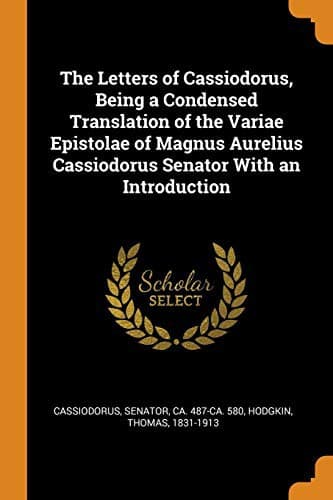
The Letters of Cassiodorus: Being a Condensed Translation of the Variae Epistolae of Magnus Aurelius Cassiodorus SenatorCassiodorus, Senator
History
The Letters of Cassiodorus: Being a Condensed Translation of the Variae Epistolae of Magnus Aurelius Cassiodorus Senator
Cassiodorus, Senator
Goths -- Italy; Italy -- History -- 476-1268
It was while Cassiodorus was holding this agreeable but not important
position, that the opportunity came to him, by his dexterous use of
which he sprang at one bound into the foremost ranks of the official
hierarchy. On some public occasion it fell to his lot to deliver an
oration in praise of Theodoric[21], and he did this with such
admirable eloquence--admirable according to the depraved taste of the
time--that Theodoric at once bestowed upon the orator, still in the
first dawn of manhood[22], the 'Illustrious' office of Quaestor,
giving him thereby what we should call Cabinet-rank, and placing him
among the ten or eleven ministers of the highest class[23], by whom,
under the King, the fortunes of the Gothic-Roman State were absolutely
controlled.
[Footnote 21: 'Cassiodorus Senator ... juvenis adeo, dum patris
Cassiodori patricii et praefecti praetorii consiliarius fieret et
laudes Theodorichi regis Gothorum facundissime recitasset, ab eo
quaestor est factus' (Anecdoton Holderi, ap. Usener, p. 4).]
[Footnote 22: He himself says, or rather makes Theodoric's grandson
say to him, 'Quem _primaevum_ recipiens ad quaestoris officium, mox
reperit [Theodoricus] conscientia praeditum, et legum eruditione
maturum' (Var. ix. 24).]
[Footnote 23: At this time the Illustres actually in office would
probably be the Praefectus Praetorio Italiae (Cassiodorus the father),
the Praefectus Urbis Romae, the two Magistri Militum in Praesenti, the
Praepositus Sacri Cubiculi, the Magister Officiorum, the Quaestor, the
Comes Sacrarum Largitionum, the Comes Rerum Privatarum, and the two
Comites Domesticorum Equitum et Peditum.]
[Sidenote: Nature of the Quaestor's office.]
The Quaestor's duty required him to be beyond all other Ministers the
mouthpiece of the Sovereign. In the 'Notitia[24]' the matters under
his control are concisely stated to be 'Laws which are to be dictated,
and Petitions.'
[Footnote 24: 'Sub dispositione viri illustris Quaestoris
Leges dictandae
Preces.
Officium non habet sed adjutores de scriniis quos voluerit.']
Public-domain text, read in full here on John Shaqi.
Reviews
Reviews
No reviews yet
Be the first to share your thoughts on this work.
Join the Discussion
Join the discussion
Sign in to leave a comment or review.
Sign InorCreate an account