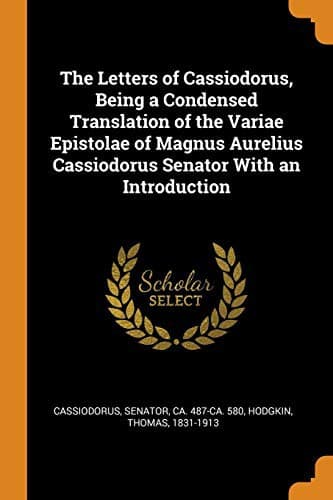
The Letters of Cassiodorus: Being a Condensed Translation of the Variae Epistolae of Magnus Aurelius Cassiodorus SenatorCassiodorus, Senator
History
The Letters of Cassiodorus: Being a Condensed Translation of the Variae Epistolae of Magnus Aurelius Cassiodorus Senator
Cassiodorus, Senator
Goths -- Italy; Italy -- History -- 476-1268
The point which we may note is, that this policy of toleration or
rather of absolute fairness between warring creeds, though not
initiated by Cassiodorus, seems to have thoroughly commended itself to
his reason and conscience. It is from his pen that we get those golden
words which may well atone for many platitudes and some ill-judged
display of learning: _Religionem imperare non possumus, quia nemo
cogitur ut credat invitus_[30]. And this tolerant temper of mind is
the more to be commended, because it did not proceed from any
indifference on his part to the subjects of religious controversy.
Cassiodorus was evidently a devout and loyal Catholic. Much the larger
part of his writings is of a theological character, and the
thirty-five years of his life which he passed in a monastery were
evidently
'Bound each to each in natural piety'
with the earlier years passed at Court and in the Council-chamber.
[Footnote 30: Var. ii. 27.]
[Sidenote: Date of the commencement of the Variae.]
We cannot trace as we should like to do the precise limits of time by
which the official career of Cassiodorus was bounded. The 'Various
Letters' are evidently not arranged in strict chronological order, and
to but few of them is it possible to affix an exact date. There are
two or three, however, which require especial notice, because some
authors have assigned them to a date previous to that at which, as I
believe, the author entered the service of the Emperor.
[Sidenote: Letter to Anastasius.]
The first letter of the whole series is addressed to the Emperor
Anastasius. It has been sometimes connected with the embassy of
Faustus in 493, or with that of Festus in 497, to the Court of
Constantinople, the latter of which embassies resulted in the
transmission to Theodoric of 'the ornaments of the palace' (that is
probably the regal insignia) which Odovacar had surrendered to Zeno.
But the language of the letter in question, which speaks of 'causas
iracundiae,' does not harmonise well with either of these dates, since
there was then, as far as we know, no quarrel between Ravenna and
Constantinople. On the other hand, it would fit perfectly with the
state of feeling between the two Courts in 505, after Sabinian the
general of Anastasius had been defeated by the troops of Theodoric
under Pitzias at the battle of Horrea Margi; or in 508, when the
Byzantine ships had made a raid on Apulia and plundered Tarentum. To
one of these dates it should probably be referred, its place at the
beginning of the collection being due to the exalted rank of the
receiver of the letter, not to considerations of chronology.
[Sidenote: Letters to Clovis.]
Public-domain text, read in full here on John Shaqi.
Reviews
Reviews
No reviews yet
Be the first to share your thoughts on this work.
Join the Discussion
Join the discussion
Sign in to leave a comment or review.
Sign InorCreate an account