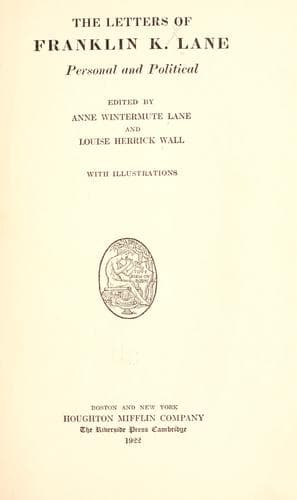
The Letters of Franklin K. Lane, Personal and PoliticalLane, Franklin K.
History
The Letters of Franklin K. Lane, Personal and Political
Lane, Franklin K.
United States -- Politics and government -- 1913-1921; World War, 1914-1918 -- United States
One of the things McAdoo said was that we could not financially
sustain the war for two years. He was for an armistice that would
compel Germany to keep the peace, military superiority recognized
by Germany, with Foch, Haig, and Pershing right on top of them all
the time. Secretary Wilson came back with his suggestion that the
Allies be consulted. Then Baker wrote a couple of pages outlining
the form of such a Note suggesting an armistice. I said that this
should be sent to our "partners" in the war, without giving it to
the world, that we were in a confidential relation to France and
England, that they were in danger of troubles at home, possible
revolution, and if the President, with his prestige, were to ask
publicly an armistice which they would not think wise to grant, or
which couldn't be granted, the sending of such a message into the
world would be coercing them. The President said that they needed
to be coerced, that they were getting to a point where they were
reaching out for more than they should have in justice. I pointed
out the position in which the President would be if he proposed an
armistice which they (the Allies) would not grant. He said that
this would be left to their military men, and they would
practically decide the outcome of the war by the terms of the
armistice, which might include leaving all heavy guns behind, and
putting, Metz, Strasburg, etc., in the hands of the Allies, until
peace was declared.
I suggested that Germany might not know what the President's terms
were as to Courland, etc., that this was not "invaded territory."
He replied that they evidently did, as they now were considering
methods of getting out of the Brest-Litovsk treaty. He said he was
afraid of Bolshevism in Europe, and the Kaiser was needed to keep
it down--to keep some order. He really seemed alarmed that the
time would come soon when there would be no possibility of saving
Germany from the Germans. This was a new note to me.
He asked Secretary Wilson if the press really represented the
sentiment of the country as to unconditional surrender. Wilson
said it did. He said that the press was brutal in demanding all
kinds of punishment for the Germans, including the hanging of the
Kaiser. At the end of the meeting, which lasted nearly two hours,
he asked to be relieved of Departmental matters as he was unable
to think longer. I wrote a summary of the position he took, and
read it after Cabinet meeting to Houston and Wilson, who agreed.
It follows:--
If they (the Allies) ask you (the President), "Are you satisfied
that we can get terms that will be satisfactory to us without
unconditional surrender?"
You will answer, "Yes--through the terms of the Armistice."
"By an armistice can you make sure that all the fourteen
propositions will be effectively sustained, so that militarism and
imperialism will end?"
Public-domain text, read in full here on John Shaqi.
Reviews
Reviews
No reviews yet
Be the first to share your thoughts on this work.
Elsewhere in the archive
Join the Discussion
Join the discussion
Sign in to leave a comment or review.
Sign InorCreate an account