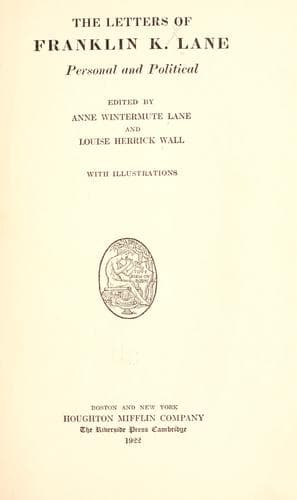
The Letters of Franklin K. Lane, Personal and PoliticalLane, Franklin K.
History
The Letters of Franklin K. Lane, Personal and Political
Lane, Franklin K.
United States -- Politics and government -- 1913-1921; World War, 1914-1918 -- United States
"Yes, because we will be masters of the situation and will remain
in a position of supremacy until Germany puts into effect the
fourteen propositions."
"Will that be a lasting peace?"
"It will do everything that can be done without crushing Germany
and wiping her out--everything except to gratify revenge."
November 1, 1918
At last week's Cabinet we talked of Austria--again we talked like
a Cabinet. The President said that he did not know to whom to
reply, as things were breaking up so completely. There was no
Austria-Hungary. Secretary Wilson suggested that, of course, their
army was still under control of the Empire, and that the answer
would have to go to it.
Theoretically, the President said, German-Austria should go to
Germany, as all were of one language and one race, but this would
mean the establishment of a great central Roman-Catholic nation
which would be under control of the Papacy, and would be
particularly objectionable to Italy. I said that such an
arrangement would mean a Germany on two seas, and would leave the
Germans victors after all. The President read despatches from
Europe on the situation in Germany--the first received in many
months.
Nothing was said of politics--although things are at a white heat
over the President's appeal to the country to elect a Democratic
Congress. He made a mistake. ... My notion was, and I told him so
at a meeting three or four weeks ago, that the country would give
him a vote of confidence because it wanted to strengthen his hand.
But Burleson said that the party wanted a leader with GUTS--this
was his word and it was a challenge to his (the President's)
virility, that was at once manifest.
The country thinks that the President lowered himself by his
letter, calling for a partisan victory at this time. ... But he
likes the idea of personal party-leadership--Cabinet
responsibility is still in his mind. Colonel House's book, Philip
Dru, favors it, and all that book has said should be, comes about
slowly, even woman suffrage. The President comes to Philip Dru in
the end. And yet they say that House has no power. ...
Election Day. November 5, [1918]
At Cabinet some one asked if Germany would accept armistice terms.
The President said he thought so. ...
Public-domain text, read in full here on John Shaqi.
Reviews
Reviews
No reviews yet
Be the first to share your thoughts on this work.
Elsewhere in the archive
Join the Discussion
Join the discussion
Sign in to leave a comment or review.
Sign InorCreate an account