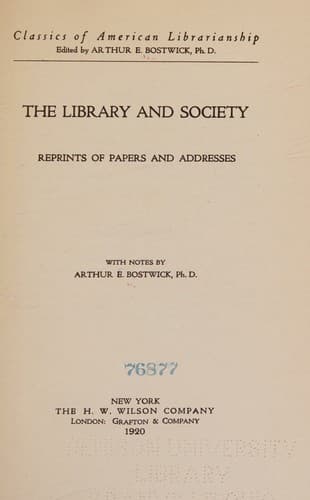
The Library and Society: Reprints of Papers and Addresses
History
The Library and Society: Reprints of Papers and Addresses
Libraries and society; Library science -- Social aspects
In these elegant and spacious buildings the whole public of Hartford is
welcome, without money and without price. The circulating library will
furnish every home with books, and Miss Hewins, who has devoted her life
to this town, is always ready to help the younger readers. The Library
of Reference, monument alike to Mr. Watkinson's liberality and Dr.
Trumbull's rare judgment and life-long devoted service as a librarian,
offers free to all students the authorities on every branch of
knowledge. The Historical Society, with improved facilities, has been
able to adopt a more liberal policy, and is widening its claim upon
public interest, and so increasing its usefulness, and, thanks largely
to the women of Hartford, the Art Gallery and Art School are ready to
spread their refining and wholesome influence all through this
community.
LIBRARIES AS LEAVEN
This address was delivered at the inauguration of the Free
Public Library, Madison, Wis., by Prof. James D. Butler.
James Davie Butler was born in Rutland, Vt., March 15, 1815,
and was graduated at Middlebury College, Vt., in 1836. He
entered the Congregational ministry, and held the chairs of
ancient languages in Wabash College, 1854-58 and the
University of Wisconsin, 1858-67, after which he devoted
himself to lecturing and writing until his death in Madison
in 1905.
My subject is "Libraries as Leaven," or the relation of libraries to the
increased diffusion of knowledge.
What is a Library? It is the knowledge of all brought within the reach
of each one. It is an expanded encyclopædia, or the books which are, or
ought to be, consulted in compiling a perfect encyclopædia.
Human knowledge--and hence the books in which it is treasured up--is
divided by some authors into forty departments. I have their names here
all written down--but I dare not read them. You would give no more
quarter to such a catalogue than the lover gave to the mercantile
inventory of his sweetheart's charms, when itemized as "two lips
indifferent red," "two gray eyes with lids to them," and so on.
But all these forty classes of knowledge ought to be represented in a
library, and the more largely the better. They should also mingle there
in due proportion, "parts into parts reciprocally shot, and all so
forming a harmonious whole." "If the whole body were an eye, where were
the hearing?"
I once lived in a town of a thousand families, where, through a legacy,
one copy of some single author was annually presented to each family.
But, with the same money, a thousand different works might have been
every year purchased, and all kept accessible by all the families. The
result would have been a feast as appetizing to all palates as the
miraculous manna which the rabbins tell us tasted to each Jew like that
particular dainty which he loved best.
Public-domain text, read in full here on John Shaqi.
Reviews
Reviews
No reviews yet
Be the first to share your thoughts on this work.
Elsewhere in the archive
Join the Discussion
Join the discussion
Sign in to leave a comment or review.
Sign InorCreate an account