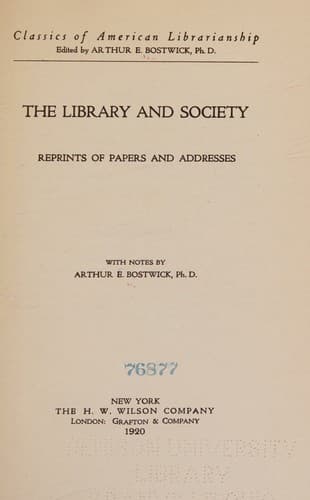
The Library and Society: Reprints of Papers and Addresses
History
The Library and Society: Reprints of Papers and Addresses
Libraries and society; Library science -- Social aspects
It is no objection to a library that no man will ever read it through.
No man will read through his dictionary, and time is not long enough for
a man to read all the words in the daily _Tribune_. Nor will any
customer exhaust a store. Yet he demands an assortment from which to
select the little that he needs. In every library most authors, bound up
in congenial calf, sleep soundly in their own sheets. Yet the dust of
dead men's bones, at the touch of genius, comes forth in a new life. How
much that is best in Macaulay and in Buckle is extracted from
bibliothecal rubbish--or reading which had never been read. Hence even
Samson could not say to the jaw-bone of an ass: "I have no need of you."
The wise thank God for fools. They get their living out of them, and
mostly out of the greatest fools. In truth, no library is large enough.
Guizot and Michelet complain of inability to consult certain books, even
in that Parisian library, where books are as plenty as water in the
deluge, and the shelves would reach from here to Milwaukee.
A library should be a cosmos; but it is a chaos till arrangement,
catalogues and librarians bring us at once the volume we desire, and
which, without them, would be as hard to fish up as the Atlantic cable
lost in mid-ocean.
"Thus warlike arms in magazines we place,
All ranged in order and disposed with grace:
Not thus alone the curious eye to please,
But to be _found_, when need requires, with ease."
In some libraries, however, books are arranged on a system which seems
borrowed from Spanish hospitals, where patients are arranged according
to religious creeds, rather than bodily complaints. Every library has
more volumes than I can master; but no library though it be the conflux
of all civilizations, has so many volumes as I may need to consult.
Chief Justice Story used to assert that no American could test the
accuracy of Gibbon without crossing the Atlantic. Such an assertion
would now, perhaps, be extravagant, yet many of Gibbon's references are
still hard to trace in America. One instance may be worth notice. Our
approaching national centenary leads us to curiosity in reference to the
secular feasts of the Romans. In Gibbon's account of the most famous
among them, a thousand years from the founding of Rome, the main
authority quoted is Zosimus. But the history of Zosimus you will seek in
vain throughout Madison libraries. You will not find his name in the
public collections of Chicago, or Cincinnati, or St. Louis, or San
Francisco. It is unlikely that any single copy of Zosimus has yet
penetrated west of our Atlantic slope.
But how dare I thus speak about Zosimus? How is it possible for me to
know whether his history can, or cannot, be discovered, either on the
Pacific shore, or in the Mississippi valley? I know it, thanks to the
Library of Our Historical Society, and specifically to its goodly array
of bibliothecal catalogues.
Public-domain text, read in full here on John Shaqi.
Reviews
Reviews
No reviews yet
Be the first to share your thoughts on this work.
Elsewhere in the archive
Join the Discussion
Join the discussion
Sign in to leave a comment or review.
Sign InorCreate an account