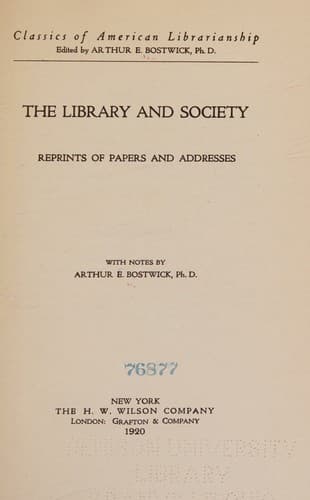
The Library and Society: Reprints of Papers and Addresses
History
The Library and Society: Reprints of Papers and Addresses
Libraries and society; Library science -- Social aspects
But, in the second place, in that year 1731, who was Franklin who did
all that, and who were the persons who helped to do it? He and they were
young men; obscure men, poor men, laboring men; mechanics and tradesmen
of the town where they lived; young men just getting a start in the
world. So this new era in the brain life of the American people had its
beginning with such as they were. Who of us, therefore, however modest
be our lot in life, has any right to say to himself, "I am not in
position to do anything for the advancement of my race"? Nay; my
brother, think of young Ben Franklin, the printer, and his 50 brother
mechanics; remember what they accomplished; and do not despair of being
useful in your time also. And in the third place, this movement came
from those young men associated together in a social debating club. It
was their experience in the actual discussion of the problems of human
thought which made them feel the need of books and suggested this great
measure for popularizing books: a fact which fits in well with Mr.
Sage's idea of blending the two things together here; of giving
perpetual house-room and hospitality to a debating club, here, in the
very midst of this library. And now the fourth point is, that the plan
started by Franklin and those other young mechanics in Philadelphia, in
1731, the plan of joint-stock library associations, worked so well there
that, as Franklin tells, it was taken up in other provinces. Naturally,
the new plan was adopted first in the towns where it was heard of
first--the towns nearest to Philadelphia. But before many years, the
news of it had travelled far, to the southward and the northward, and
whether consciously or unconsciously the model set up in Philadelphia,
was imitated, with more or less closeness, in scores of places far away.
One curious example springs up in South Carolina. It is in the
Georgetown district, then given to the growth of indigo. A number of the
planters came together and formed the Winyaw Indigo Society. Their chief
business was to have a pleasant time together and talk indigo; they paid
their initiation fees in indigo; they paid their annual dues in indigo;
and presently they found their treasury so full and overflowing with
indigo, that they resolved to devote their surplus in part to the
formation of the Indigo Society Library. Then, too, at about the same
time in Charleston, seventeen young men, of very limited means, desirous
of seeing the best and freshest English magazines, formed a club for
that purpose, and started with a fund of ten pounds sterling, not
venturing at first to hope to be able to purchase books also. Soon,
however, their plan grew and took in books; and from this small
beginning arose the great "Library Society" of Charleston, which has
ministered to the pleasure and benefit of the people of that place for
nearly a century and a half.
Public-domain text, read in full here on John Shaqi.
Reviews
Reviews
No reviews yet
Be the first to share your thoughts on this work.
Join the Discussion
Join the discussion
Sign in to leave a comment or review.
Sign InorCreate an account