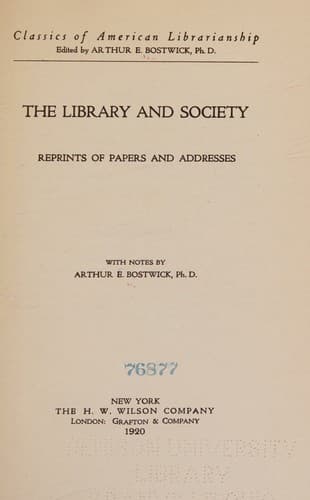
The Library and Society: Reprints of Papers and Addresses
History
The Library and Society: Reprints of Papers and Addresses
Libraries and society; Library science -- Social aspects
"The books were distributed to the districts by the town clerk to be
returned by the directors every third month for exchange. This would now
require more than 60,000 miles' travel per annum, at a positive expense
to the directors, certainly, of $100,000, to say nothing of more than
10,000 days' time. This was like putting two locomotives ahead of each
other to draw a hand-car. The result was the books were generally hidden
away in the clerks' offices, like monks in their cloister, and valueless
to the world. And what kind of books were they? Some good ones,
doubtless; but generally it was better to sow oats in the dust that
covered those books than to give them to the young to read. Every year,
soon after the taxes were collected, the state swarmed with pedlers,
with all the unsalable books of Eastern houses--the sensational novels
of all ages, tales of piracies, murders, and love intrigues--the
yellow-covered literature of the world."
Finally, the superintendent for 1873 says: "The whole system seems to
have come into general disfavor; and is, more than any other feature of
our school system, the one of which we are least proud."
Now we come to the fifth stage in the evolution of libraries--that of
libraries fully endowed by private generosity, and thrown open to the
public on such conditions as the founders have been pleased to indicate;
sometimes called patronymic libraries. Notable specimens of this class
of libraries are the Astor, Cooper, and Lenox Libraries, of New York,
and the Peabody Library, of Baltimore. The note of this species of
library is this: it is for the use of the public entirely without cost
to the public. In short, it is a library completely endowed, not only as
to the original expense of its erection and equipment, but absolutely
for all subsequent expense in its increase and administration.
Concerning this species of library, I have this to say: It is a noble
use to make of private wealth; it does immense good; but it is not the
best final form of library evolution. And for two reasons: first, the
man who will completely endow a free public library does not arise in
every community; whereas, every community needs a free public library.
And, second, the wholesomest kind of a gift is not that which does it
all for the community and requires no exertion or sacrifice on their
part; but that which gives the community a good generous start, but
still leaves something for the community to do for itself. In other
words, the healthiest sort of help, whether for one man or for ten
thousand, is that help which helps a man to help himself.
Public-domain text, read in full here on John Shaqi.
Reviews
Reviews
No reviews yet
Be the first to share your thoughts on this work.
Join the Discussion
Join the discussion
Sign in to leave a comment or review.
Sign InorCreate an account