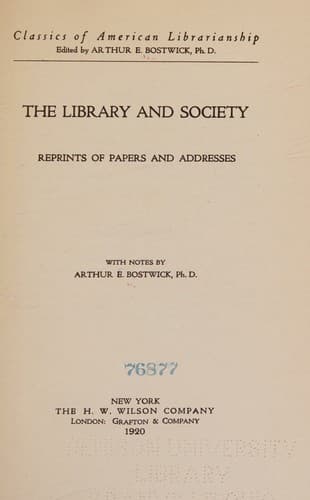
The Library and Society: Reprints of Papers and Addresses
History
The Library and Society: Reprints of Papers and Addresses
Libraries and society; Library science -- Social aspects
But Mr. O'Brien's concern is manifested also for the taxpayer, who
unites in the public support of the library. If we understand him
correctly, his contention is that the enormity of this tax consists
largely in the reprehensible nature--as represented in his pages--of the
institution itself. For from this short chapter one gradually frames a
picture of the free library as a place which tramps frequent for
sleeping off the effects of dissipation; as a place used by commercial
travellers for exhibiting their samples; as a place from which in one
instance "a respectable thief took away £20 worth of books"; as a place
used in an almost exclusive degree for reading fiction; as a place where
the time prescribed for keeping books makes 'serious study' impossible;"
and, more serious than all the rest, as a place which, he says, "favors
one special section of the community at the expense of all the rest."
Let us do Mr. O'Brien the justice to add that for the first three of
these counts he gives "chapter and verse" for his charges, quoting,
namely, from various (English) library reports. No one will therefore
wish to dispute his well-fortified statement that in such and such an
instance an unseemly incident occurred. But even a child can assuredly
see the difference between a statement of an isolated occurrence and an
inference that it is a necessarily characteristic and inherent quality
of the institution in question. Were this latter true, then we might
well cry out for abolishing our churches, sidewalks, and railway
stations, for in them these very same three things respectively are
known at some time to have been done. In the last three of these counts,
however, we have only Mr. O'Brien's assertions as the basis, and we are
obliged to add also that even these are found to be conflicting. On one
page his language shows that he is pained that a certain percentage of
readers in the libraries named should prefer to call for works of
fiction. Can it be that he has forgotten this, when on another page he
cites it as a grievance that "it is a frequent occurrence for a reader
to wait for months before he can get the novel he wants"! On page 333,
after quoting, from the annual report of one of the English libraries,
the statement as to the use of works of fiction, nothing but a resort to
italics can sufficiently emphasize his lamentation that "the more
instructive books in the other classes circulate only once during the
same period." Mr. O'Brien is not the only observer who has failed always
to observe, when commenting upon percentages of fiction, that "any book
requiring serious study cannot be galloped through, like a novel, in the
week or fourteen days allowed for use," yet who would have believed that
"out of his own mouth" would he be so completely answered, for this
remark, as well as the one which it answers, is found in his decidedly
interesting chapter (p. 348). But here it is evident that the bearing of
Public-domain text, read in full here on John Shaqi.
Reviews
Reviews
No reviews yet
Be the first to share your thoughts on this work.
Elsewhere in the archive
Join the Discussion
Join the discussion
Sign in to leave a comment or review.
Sign InorCreate an account