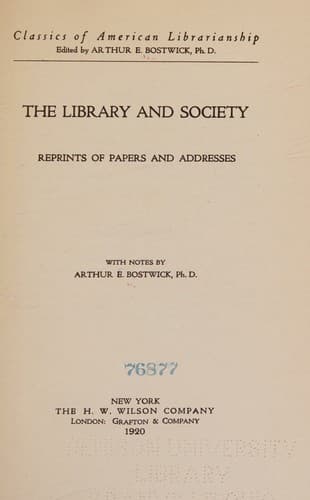
The Library and Society: Reprints of Papers and Addresses
History
The Library and Society: Reprints of Papers and Addresses
Libraries and society; Library science -- Social aspects
the two upon each other was not in his mind in writing it, for his
purpose in the sentence last quoted was plainly to make it appear that
the customary regulations of public libraries were such as to render
"serious study" impossible.
The limitation of "a week or fourteen days" for a book of the kind
which he here indicates--he instances by name Kant's "Critique of pure
reason" and Smith's "Wealth of nations"--is practically unknown in
American public libraries. In most of those known to the present writer
a book of this kind can be charged in the first instance for fourteen
days and then renewed, making twenty-eight days in all, and in still
others for a longer period. It can then, after being returned to the
library--to give any other reader who may need it a chance at it--be
taken out again after remaining on the shelves twenty-four hours, for
another twenty-eight days' use by the same reader. The annual report of
an American library which lies before us contains a case in point.
Speaking of Bryce's "American Commonwealth," it states: "Of this, seven
copies were added in succession." It names 101 as the total of the
issues of this work during the year; but considering the truth expressed
in Mr. O'Brien's own very just words, that "any book requiring serious
study cannot be galloped through, like a novel," the statement is added
that "such a record, for a book like this, constantly in the hands of
readers, may be contrasted with the more than ten times greater number
of times that some work of fiction might be read through, returned and
taken out again, requiring but a part of a day's attention." In fact,
101 is very likely to be the total number of issues possible in the case
of seven copies of this book, while 700 would probably fall far short of
the total possible issues of the same number of copies of a story like
"The Wreck of the Grosvenor." Again, Mr. O'Brien not only tells us that
"a free library favors one special section of the community" at the
expense of all the rest, but throughout his chapter recurs again and
again to the case of the "workingman." On page 330, for instance, we are
solemnly told: "If the workingman cannot come by his books honestly, let
him wait until he can." This is indeed somewhat summary, particularly
when, being interpreted, it is found to mean, Let there be no free
libraries supported by the public. And yet, on page 344, with no less
certainty, we are assured that "there is little doubt that at least
forty-nine out of every fifty workingmen have no interest whatever in
these institutions."
Public-domain text, read in full here on John Shaqi.
Reviews
Reviews
No reviews yet
Be the first to share your thoughts on this work.
Elsewhere in the archive
Join the Discussion
Join the discussion
Sign in to leave a comment or review.
Sign InorCreate an account