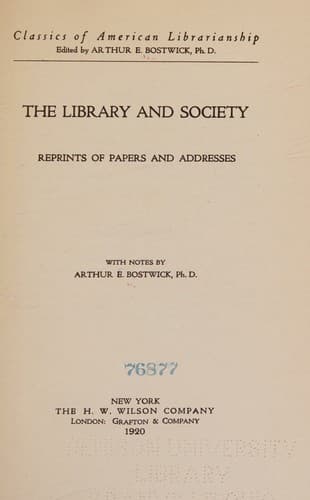
The Library and Society: Reprints of Papers and Addresses
History
The Library and Society: Reprints of Papers and Addresses
Libraries and society; Library science -- Social aspects
Again, it is important that the relation of a public library to the
question of entertainment should be clearly understood. Entertainment is
not an element totally foreign to the purposes of a public library--the
same kind of public benefit accrues in this case as in the case of
public parks--but in the light of the infinitely more important
functions which it renders, this must of necessity occupy a subordinate
place. The primary function of a library is to render a service, to
supply a need, to respond to a demand. In this respect its value to the
community is of the same description as the postal system, the bank at
which one may cash a check, or the reservoir from which one may "turn
on" a supply of water.
One of the points which Mr. O'Brien aims to make, and which proceeds
from a manifest confusion of thought, can be appropriately noticed here.
His contention is that a public library is for the "class" who may be
designated "book-readers," that these form but a small percentage of any
community, and that therefore it is obviously wrong that the library
should receive public support. This is ingenious, as is also his
eloquent, though somewhat contemptuous setting of their supposed special
needs over against those of others. "Are theatre-goers, lovers of
cricket, bicyclists, amateurs of music, and others to have their
earnings confiscated," merely that the "book-reader" may gratify his
peculiar craving? Like many other ingenious theories, however, it leaves
out of account certain fundamentally important bearings of the subject.
There can be no doubt that in any community "the book-reader" is not
synonymous with the entire population. Some of the population are
children in arms; some have never learned to read; the sight of some who
have learned has failed; others again are too fully occupied to find
time for it; others find their inclination drawn more strongly in other
directions; others still have more or less to do with reading, yet are
not, in the strict sense, "book-readers." Yet we shall err very widely
if we lose sight of the fact that even those who do not personally
perform the role of the "book-reader" do nevertheless benefit by the
existence of the library, by proxy. The young child is read to, by his
mother; or is cared for by her, by methods learned through her use of
books. The busy "captain of industry," whose large profits are due to a
skillful application of scientific principles, may find his own time so
closely occupied by details of administration that, personally, he
seldom opens the treatises which bear upon the subject, but he expects
to keep abreast of the ever unfolding science, by the consultation not
only of such works as private ownership may provide, but the more nearly
complete collection in a great public library.
Public-domain text, read in full here on John Shaqi.
Reviews
Reviews
No reviews yet
Be the first to share your thoughts on this work.
Elsewhere in the archive
Join the Discussion
Join the discussion
Sign in to leave a comment or review.
Sign InorCreate an account