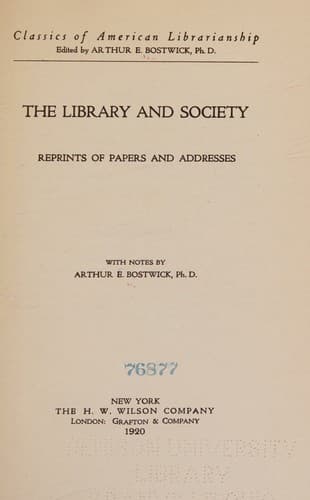
The Library and Society: Reprints of Papers and Addresses
History
The Library and Society: Reprints of Papers and Addresses
Libraries and society; Library science -- Social aspects
Where the deliverances from one and the same source are so
contradictory, the impartial inquirer will doubtless feel like looking
for some other source of information. From the materials accessible to
the present writer in regard to American libraries--and the new edition
of Mr. Greenwood's "Public libraries" appears to tell the same tale in
regard to Great Britain--the interest of workingmen in the opportunities
afforded by public libraries is everywhere emphatically shown; but he
who sets out with the purpose of showing that there is any one exclusive
class to whom the public library is of service and to no other--be that
class workingmen, or students, or manufacturers, or scientists--will
find the facts singularly obstinate and unresponsive to his purpose. The
truth is--Mr. O'Brien's confident assertion to the contrary--that there
is no more "universal" and non-partisan institution than a public
library. This is undoubtedly the highest among its several claims to
public support. Few among the objects to which the public funds have
been appropriated, in American cities, have met with so hearty and
unquestioning approval as the public parks, and it is right that it
should be so. Yet there are whole classes in every community who not
only never do enjoy the public parks, but never care to enjoy them. Even
the public schools are for a certain fraction of the population
only--the younger portion. In contrast with both of these, the public
library extends its resources to the children and the adults alike.
Perhaps, however, the fundamentally important question of universality,
in the sense of non-partisanship, is one which is seldom appreciated in
its full force, as applied to a public library. An independent position,
one entirely free from bias, a non-partisan attitude, in fact, is an
ideal repeatedly set before the conductors of a school or a newspaper.
In both these cases, however, there is too often an element of practical
difficulty in carrying these praiseworthy intentions into practice,
which is almost completely wanting in the case of a public library. The
policy of the latter, is, in its very essence, catholic. It places on
its shelves the volumes which represent, not one side, but both, or
rather all sides of any subject on which the sentiment of the public
divides; and thus, whether the user be Democrat or Republican,
protectionist or freetrader, Catholic or Protestant, the aspect which
this collection of books presents to him is no less free and
uncircumscribed than the illimitable aid.
Public-domain text, read in full here on John Shaqi.
Reviews
Reviews
No reviews yet
Be the first to share your thoughts on this work.
Elsewhere in the archive
Join the Discussion
Join the discussion
Sign in to leave a comment or review.
Sign InorCreate an account