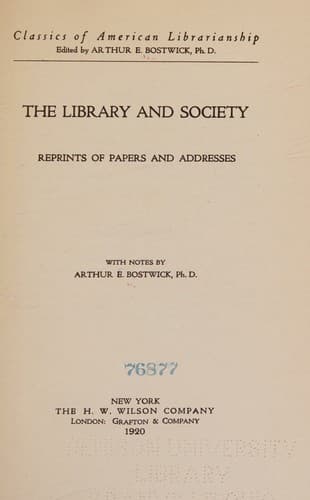
The Library and Society: Reprints of Papers and Addresses
History
The Library and Society: Reprints of Papers and Addresses
Libraries and society; Library science -- Social aspects
This rapid and wonderful transformation has been the work of human hands
guided by intelligent brains and an indomitable spirit of pluck and
perseverance. We are accustomed to think of this combination as purely
American. In many of its characteristics it certainly is so. And in no
respect more distinctively so than in the cause in which we are most
interested. Not all the older commonwealths, even on this side of the
Atlantic, have yet accepted the theory that the education of the citizen
is the concern of the state. But in all this newer portion of our
country this doctrine has been incorporated into the fundamental law.
The ordinance of 1787 for the government of the territory northwest of
the Ohio river declared that for obvious reasons schools and the means
of education shall be forever encouraged. The twenty states now
organized within this and the subsequently acquired territory to the
westward have all accepted to the fullest extent the doctrine of the
ordinance. They have not only carried it into practical effect by
general laws providing for free public schools for children, for
universities and institutions of higher learning for the education of
youth, but have also provided for the establishment and maintenance of
free public libraries at the general expense and for the common use of
all the people.
Let us consider very briefly the theory upon which the state assumes to
levy tribute upon the property of individuals to provide means for
maintaining libraries. By what right does the state tax the man of
wealth to put miscellaneous books into the hands of the man who pays no
tax?
So far as primary education is concerned, the basis seems clear. The
free state which depends for its very existence upon the intelligence of
the masses of its citizens must, as a measure of self-defense, provide
the facilities by which all may become intelligent. Self-preservation is
the supremest natural law. Whatever has a right to exist has a right to
do that which is necessary to preserve its existence. The free state
which rests on the suffrage of its citizens is bound in duty to itself
to see to it that popular education, which is essential to its
perpetuity, is universal. Ignorant men are not competent to take care of
themselves and their households, still less to direct the destinies of
an empire. The state has, therefore, the right, not only to provide the
means of education, but to compel education. Laws are in force which
require certain attendance upon the schools. These rest on the theory
that the interest of the state in the education of the individual
surpasses that of the individual, and therefore, the state cannot, in
justice to itself, treat education purely as a matter of individual
concern.
Public-domain text, read in full here on John Shaqi.
Reviews
Reviews
No reviews yet
Be the first to share your thoughts on this work.
Elsewhere in the archive
Join the Discussion
Join the discussion
Sign in to leave a comment or review.
Sign InorCreate an account