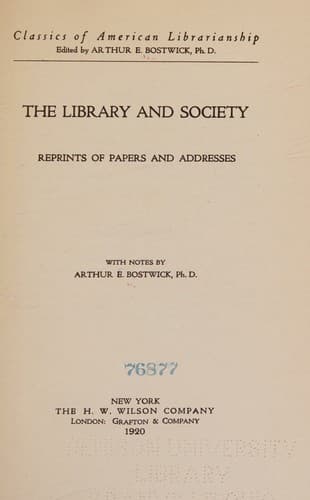
The Library and Society: Reprints of Papers and Addresses
History
The Library and Society: Reprints of Papers and Addresses
Libraries and society; Library science -- Social aspects
It is a notorious fact that the average person does not perceive the
importance of self-cultivation. As the vineyard left to itself is soon
choked out with weeds and chapparall, so man if left to himself lapses
naturally into his primitive condition. The state cannot leave him to
himself, but must interpose to make it certain that he acquires the best
degree of information which his natural abilities and the time not
necessary to his self-support shall permit. Neither can the state leave
the matter of providing facilities and inducements to education to
private enterprise, nor to the church, which has been the foremost of
all organizations to appreciate its importance. While the state
recognizes these agencies and accepts them as satisfactory, so far as
they go, it nevertheless fully equips schools of its own, in pursuance
of its inherent right and duty, which cannot be relinquished to any
other agency.
The extent to which the state shall go in the matter of educating its
citizens has been the subject of much discussion. There are those who
maintain that as the education of the individual proceeds his concern in
his own development increases, until finally, if his education proceeds
far enough, his concern in his own development surpasses that of the
state, and he must thenceforth be left to equip himself entirely at his
own expense. If that point is marked by the line between primary and
secondary, or between secondary and higher education, there is where the
state is in duty bound to stop. The extent of the interest of the
community as compared with that of the individual is held to grow less
and less and finally to disappear as he advances.
But the better judgment of our time repudiates this theory, and holds
apparently that there is no limit to the concern of the state in the
mental progress of the individual. Ian Maclaren in his touching story of
"Domsie" quotes John Knox as saying: "Ilka scholar is something added to
the riches of the commonwealth." It can probably be demonstrated by the
rules of accounts that as a business investment the state is wisely
spending money in the education of the people. The cost is more than
returned to it in the material development which an enlightened
citizenship ensures. If we contrast our own country, where education is
free, with some older countries where it is yet held to be a matter of
minor concern, or if we contrast some of the states of this republic
with others of corresponding age, we shall see at a glance a wide
difference in material resources and prosperity. In one the industrial
arts are far advanced, there is intellectual activity, the average
citizen is well clothed, well housed, and enjoys many luxuries; in the
other, the methods and life of a past century prevail and poverty and
ill-living are the rule. This, if not the highest motive, is an
incidental one of considerable importance for doing at the common
expense that which is for the common good.
Public-domain text, read in full here on John Shaqi.
Reviews
Reviews
No reviews yet
Be the first to share your thoughts on this work.
Elsewhere in the archive
Join the Discussion
Join the discussion
Sign in to leave a comment or review.
Sign InorCreate an account