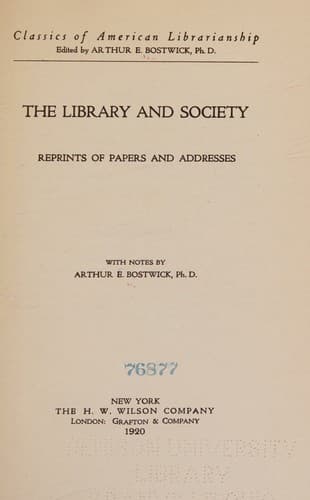
The Library and Society: Reprints of Papers and Addresses
History
The Library and Society: Reprints of Papers and Addresses
Libraries and society; Library science -- Social aspects
The recent extension of suffrage in England has strengthened the system.
No candidate for official position who opposed it could hope for
success. It has been found that free libraries have not degenerated into
political clubs and schools of agitation. No trouble has arisen in the
selection of books, and no censorship of the press was required. It was
at first supposed that all books relating to religion and politics--the
subjects on which people quarrel most--must be excluded. The experiment
of including these books was tried in the Manchester and Liverpool
libraries, where the books were purchased by private subscription, and
no controversy arising therefrom, all apprehension of evil from this
cause was allayed. Parliament doubled the rate of taxation, and
permitted the purchase of books from the public funds. The adoption of
the compulsory system has not imposed a check on the voluntary and
self-supporting desire of possessing books which existed among the
people. It has strengthened that desire; and ample proof of this
statement could be furnished if the prescribed limits of this paper
would permit.
It is singular that objections to public libraries have come mainly from
men--as we have seen from the debate in the British Parliament--who are
educated, and in general matters of public welfare are intelligent above
their fellows. These objections, however, were uttered before the
persons making them had given the subject any attention, and hence they
were disqualified from entertaining an opinion.
Nearly all the objections to public libraries which have been expressed
in this country--and these appear more frequently in private
conversation than in the public prints--may be classed under three
heads:
1. The universal dread of taxation. Libraries cost money. In every city
and town of the land there is a feeling that the present rate of
taxation is all that the property and business of the place will bear.
This feeling existed before the taxes were one half their present rates.
There is a generous rivalry among our cities and towns in the
maintenance of good schools; and localities which furnish the best
facilities for education are regarded as the most desirable places for
residence. Viewed simply as a matter of public economy, no city can
afford to dispense with its educational system, or to permit it to
degenerate. The public library also should be maintained as the
supplement of the public school, carrying forward the education of the
people from the point where the public school leaves it.
Public-domain text, read in full here on John Shaqi.
Reviews
Reviews
No reviews yet
Be the first to share your thoughts on this work.
Elsewhere in the archive
Join the Discussion
Join the discussion
Sign in to leave a comment or review.
Sign InorCreate an account