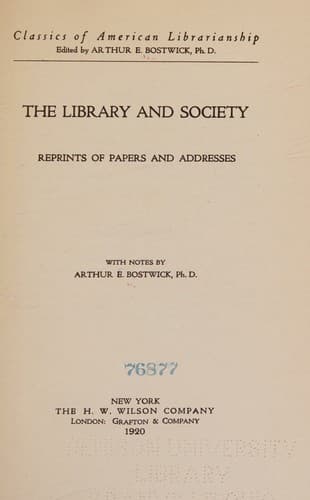
The Library and Society: Reprints of Papers and Addresses
History
The Library and Society: Reprints of Papers and Addresses
Libraries and society; Library science -- Social aspects
2. There are certain theoretical objections offered to the establishment
and maintenance of public libraries. One is that the library tax bears
unequally upon the people. Some persons do not care to read books, and
others prefer to pay for their own reading. The same objection is quite
as valid against any system of public education. To lay the burden of
education uniformly upon property, and to tax the owner who has no
children, or, having children, prefers to educate them at private
schools, is another glaring instance of inequality. No taxation for the
maintenance of public health, the introduction of water and gas, the
construction of roads, bridges, and sewers, bears equally upon every
member of the community. If perfect equality in the distribution of
these burdens were a necessity, an organized municipality would be an
impossibility.
Perhaps the most popular objection to public libraries is the one urged
by the few disciples of Herbert Spencer--that government has no
legitimate function except the protection of person and property, as the
original compact of society is simply for the purpose of protection. All
else is paternal, pertains to the commune, and tends to perpetual
antagonism. The government may support a police, courts of justice,
prisons, penitentiaries, and similar institutions, and can do nothing
else.
How are the people under this theory to be educated? The reply is
explicit: Unless they will educate themselves, they are not to be
educated. How is the public health to be maintained? It is not to be
maintained by any interference of government. Who is to build bridges
and sewers and lay out public parks? Nobody. Imagine, if it be possible,
a community where such a Utopian theory was carried out. Such a
government fortunately does not, and never did, exist on the face of the
globe. The "general welfare"--which includes protection--is expressly
stated in the preamble of the national constitution to be the purpose of
our government, and the same expression is found in nearly all the state
constitutions. What ever the people desire, and whatever will, in their
judgment, conduce to the general welfare, is a legitimate subject for
governmental action. "The only orthodox object of the institution of
government," says Mr. Jefferson, "is to secure the greatest degree of
happiness possible to the general mass of those associated under it."
Herbert Spencer wrote his "Social Statics" before the British Parliament
passed an act for the support of public libraries. Mr. Ewart's bill was
then before Parliament; and Mr. Spencer, in that work, took occasion to
fling a sneer at it. In the preface of his American edition, written in
1864, he states, without remodelling the text, that "the work does not
accurately represent his present opinions."
Public-domain text, read in full here on John Shaqi.
Reviews
Reviews
No reviews yet
Be the first to share your thoughts on this work.
Elsewhere in the archive
Join the Discussion
Join the discussion
Sign in to leave a comment or review.
Sign InorCreate an account