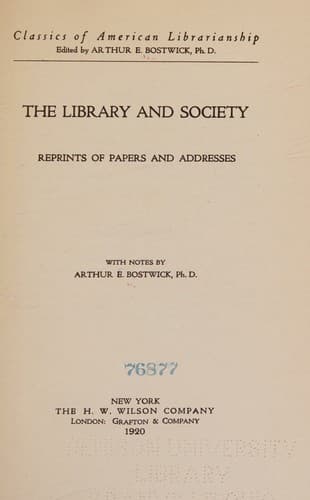
The Library and Society: Reprints of Papers and Addresses
History
The Library and Society: Reprints of Papers and Addresses
Libraries and society; Library science -- Social aspects
3. The third and last class of objections to public libraries to which
I shall direct your attention relates to the kind and quality of books
circulated. These objections, which are usually made by educated and
scholarly persons, are based on an entire misconception of the facts in
the case. The objectors do not divest themselves of the old idea that
libraries are established for the exclusive benefit of scholars; whereas
the purpose of these is to furnish reading for all classes in the
community. On no other principle would a general tax for their support
be justifiable. The masses of a community have very little of literary
and scholarly culture. They need more of this culture, and the purpose
of the library is to develop and increase it. This is done by placing in
their hands such books as they can read with pleasure and appreciate,
and by stimulating them to acquire the _habit_ of reading. We must first
interest the reader before we can educate him; and, to this end, must
commence at his own standard of intelligence. The scholar, in his pride
of intellect, forgets the progressive steps he took in his own mental
development--the stories read to him in the nursery, the boy's book of
adventure in which he revelled with delight, and the sentimental novel
over which he shed tears in his youth. Our objector supposes that the
masses will read books of his standard if they were not supplied with
the books to which he objects; but he is mistaken. Shut up to this
choice, they will read no books. When the habit of reading is once
acquired, the reader's taste, and hence the quality of his reading,
progressively improve.
The standard histories, technical works of science, and even
Shakespeare's plays and Milton's "Paradise Lost," are sealed books to a
larger portion of every community than are willing to acknowledge the
fact. "When a Boy," said John Quincy Adams, "I attempted ten times to
read Milton's 'Paradise Lost.' I was mortified, even to the shedding of
tears, that I could not conceive what it was that my father and mother
so much admired in that book. I smoked tobacco and read Milton at the
same time, and for the same motive: to find out what was the recondite
charm in them that gave my father so much pleasure. After making myself
sick four or five times with smoking, I mastered that accomplishment;
but I did not master Milton. I was nearly thirty years of age when I
first read 'Paradise Lost' with delight and astonishment."
If our objectors mourn over the standard of books which are read by the
public, they may be consoled by the fact that, as a rule, people read
books better than themselves, and hence are benefited by reading. A book
of a lower intellectual or moral standard than the reader's is thrown
aside in disgust, to be picked up and read by a person still lower in
the scale of mental and moral development.
Public-domain text, read in full here on John Shaqi.
Reviews
Reviews
No reviews yet
Be the first to share your thoughts on this work.
Elsewhere in the archive
Join the Discussion
Join the discussion
Sign in to leave a comment or review.
Sign InorCreate an account