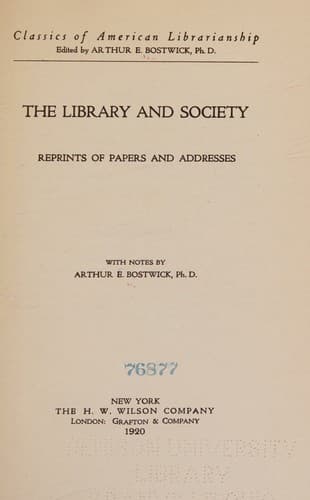
The Library and Society: Reprints of Papers and Addresses
History
The Library and Society: Reprints of Papers and Addresses
Libraries and society; Library science -- Social aspects
Now, in neither of these instances is the increase of knowledge the aim
set before the reader, but the development of some dwarfed faculty whose
growth is necessary to the leading of a noble life. But where the
increase of knowledge is the direct end sought, the value of the
knowledge in itself must not be that alone which decides one in the
choice of books, or incites him to reading, but the use to which it can
and ought to be put. An employer of labor, for instance, one who is
immediately responsible for the welfare of a large number of workmen,
cannot, with any true conception of his duty as a master, devote his
time for reading to acquiring a knowledge of history, science, or
literature, if he know nothing of the principles underlying the
relations of capital to labor, if he is ignorant of the dangers, the
temptations, the needs and rights of his workpeople. However
well-informed on other subjects, he has read to far less advantage than
if his books had been chosen with a direct purpose to fit him to do his
duty as a master. So many a parent ought, for a time at least, to read
with a view wholly to prepare himself for the wise moral and mental
training of his children. And on the other hand a man should read the
history of his country, not merely that he may not blush from conscious
ignorance of it, but that, knowing what his heritage of freedom cost to
obtain, he may also come to the conviction that it is not his to enjoy
simply, but it is a sacred trust to be accounted for, however humble his
position. It could not be more humble than Lincoln's, and yet none can
doubt that to the spirit in which he read American history was largely
due his future fitness for the great work which God gave him to do.
To what highest and most profitable use can I put my reading? is the
question then which each one should ask himself, and according as the
answer is, so should the choice be made. It may be that one will read
that he may understand better his duties and privileges as a citizen;
another, that he may be a just master, or an intelligent and faithful
workman; still another, that she may be a wise parent; while a fourth
may have the strong conviction that everything else should be laid aside
for the study of one of the masterpieces of the world's literature, that
he may develop his higher faculties and become a man thinking lofty
thoughts and capable of noble deeds.
Public-domain text, read in full here on John Shaqi.
Reviews
Reviews
No reviews yet
Be the first to share your thoughts on this work.
Elsewhere in the archive
Join the Discussion
Join the discussion
Sign in to leave a comment or review.
Sign InorCreate an account