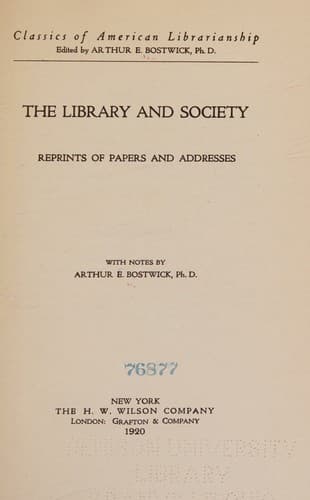
The Library and Society: Reprints of Papers and Addresses
History
The Library and Society: Reprints of Papers and Addresses
Libraries and society; Library science -- Social aspects
But in our cities and large towns there can be no doubt that the
greater number of the younger readers of a public library belong to the
second of the two classes referred to--those who have none to guide them
in the choice of their books. The most of these come, of course, simply
for amusement, without a thought of any better use of the library. But a
few come with other and higher aims. Some, with no specially strong
tastes or more than ordinary capacities, merely wish to read that which
will cultivate their minds and increase their knowledge, or will be
profitable to them in their work. A very few there are, however, in
every large town, with intellects of no mean order and strong ambitions,
who turn to the library instinctively for that which will satisfy the
cravings of their intellects and the promptings of their ambitions. A
youth with the instincts of a Lincoln or a Webster comes to read the
history of his country. Another, with the latent powers of a Nasmyth, a
Stevenson, or an Arkwright, wants the books which will give full play to
his inventive faculties. Another finds a strange and irresistible
attraction in natural phenomena, in the habits of plants and animals, in
the formation of the rocks and the hills, in the aspects of the skies
and the movements of the stars. Now, it will depend very much upon the
first choice of their books, and the subsequent direction of their
reading, whether they will become men useful to the communities in which
they live and add substantial material to the sum of human knowledge, as
statesmen, inventors, naturalists, or astronomers. The danger is that,
for lack of proper guidance and restraint, they will dissipate their
mental energies and lose sight of all high aims by too much and too
vague reading. If the public library is to be in fact, what it is in
theory, an educating power second only to the church and the school, and
supplementing the work of both, there must be some method devised by
which such readers as these may be helped to choose the right books.
Without such aid, given continually and systematically, the library
fails in the principal end for which it was founded--the elevation and
instruction of the people. We might as well turn our children into a
school-house, fully furnished with books and apparatus, but with only a
janitor to see that no injury is done to them, and expect the children
to make a wise use of their opportunities, to take up and pursue the
proper studies without the aid of a master, as to give children the free
range of a great library and expect them undirected to make a wise use
of its advantages as a means of education. It is, therefore, in my
opinion, a most pernicious error to encourage young people, of the lower
classes especially, to come to a library, and to give them poor stories
in the mistaken belief that, the taste for reading being developed, they
will naturally and surely rise from these to better books. Such a belief
Public-domain text, read in full here on John Shaqi.
Reviews
Reviews
No reviews yet
Be the first to share your thoughts on this work.
Elsewhere in the archive
Join the Discussion
Join the discussion
Sign in to leave a comment or review.
Sign InorCreate an account