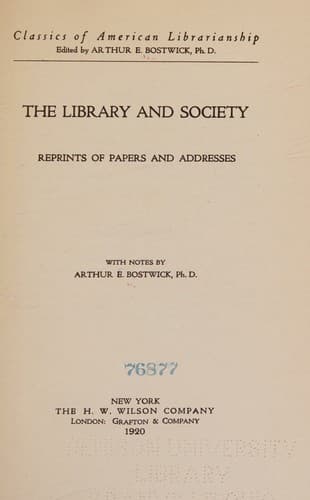
The Library and Society: Reprints of Papers and Addresses
History
The Library and Society: Reprints of Papers and Addresses
Libraries and society; Library science -- Social aspects
It is only by some such means as this that the public library can be
made a real educating power for the masses. In far too many places, now,
it is simply a place where children can get story-books at the public
expense. This cannot long continue, and I believe that the greater part
of the libraries which continue to do this work without an effort to
fulfil their higher mission, will surely and inevitably die, as the
District School and Agricultural libraries died fifty years ago. The
responsibility rests with the people of each place where there is a
public library, as to which of two ends shall be reached. It may be
merely a means for furnishing amusement for an hour, or it may be a
central beacon from whence the rays of light shall stream into every
house.
ADAPTATION OF LIBRARIES TO CONSTITUENCIES
Prepared by Samuel S. Green, then librarian of the
Worcester, Mass. Public Library and a member of the State
Library Commission, for the World's Library Congress held at
the Columbian Exposition (Chicago, 1893) and printed in the
government report thereon. The "adaptation" favored by Mr.
Green consists in weeding out unfitting books. Melvil Dewey,
as editor of this volume of papers, tells us in a foot-note
that in the discussion of Mr. Green's paper, this process
was not generally approved except as the first step in a
transfer to other libraries. President Eliot's suggestion of
reservoir libraries for storage is a later stage, in the
same line of thought. A sketch of Mr. Green appears in Vol.
I. of this series.
NOTE.--With this paper should be read those pages of the
Chicago discussions in which it was pointed out by leading
librarians that to weed out safely would require much costly
expert service; that the most hurtful criticism would be
attacks after inevitable cases where some one would greatly
wish a book that had been withdrawn as useless; that the
printed catalogs already circulated would be made
untrustworthy by parting with any volume included; that what
one wise and learned man would throw out as trash, another
equally wise and learned would consider specially valuable
because of differing personal equations. In short, that
however excellent in theory, it was perhaps the most
difficult thing in librarianship to put successfully in
practice.
While few favored "weeding out" simply to gain room by
getting rid of books little wanted, many believe in
transferring to other libraries which have a distinctly
greater need of them.--M.D.
Public-domain text, read in full here on John Shaqi.
Reviews
Reviews
No reviews yet
Be the first to share your thoughts on this work.
Elsewhere in the archive
Join the Discussion
Join the discussion
Sign in to leave a comment or review.
Sign InorCreate an account