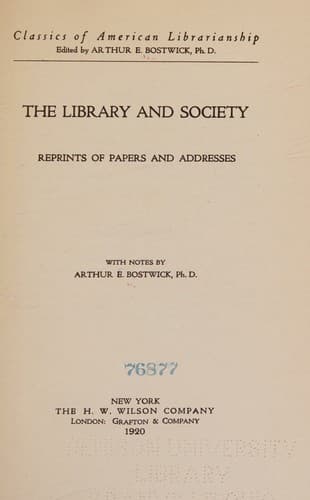
The Library and Society: Reprints of Papers and Addresses
History
The Library and Society: Reprints of Papers and Addresses
Libraries and society; Library science -- Social aspects
A resident of a Massachusetts town to which the Commonwealth was about
to give $100 worth of books came to secure my influence as a member of
the State free public library commission to have a large part of the
$100 spent for rare and expensive books on Massachusetts history. As a
large and valuable library made up principally of books of that class
was soon to be given to another small town in the same county, it would
have been manifestly unwise to grant this request. It seems unwise also
to place a students' library in a small town where there are few who
will use it. It would be better to give the library to a flourishing
institution at a county seat, on condition that it shall be open for
free consultation by all residents of the county, and that, under proper
rules, books may be lent from it to inhabitants of smaller towns for use
at home.
In this way the library would be so placed that most persons wishing to
make investigations would have the books near home, and the
comparatively few investigators in the smaller towns, such as the man in
the town first mentioned, would also have their interests provided for.
The trustees of the Thomas Crane Public Library at Quincy, Mass., have
concluded, utilizing the experience of many years, that a working
library of 15,000 volumes is sufficient to supply the general wants of
the 20,000 residents of the city. It is proposed not to let the library
grow beyond 20,000 volumes while the wants of the city remain what they
are, and when it exceeds that number of volumes to cut it down by taking
out books that never have been needed in a popular library like that in
Quincy or that have become useless. It having become evident that an
addition would presently have to be made to the building if the recent
rate of increase should continue, it seemed best to the trustees to
begin at once to reduce the size of the library. They proceeded, under
the able leadership of Mr. Charles Francis Adams, to remove from the
library large numbers of Government documents, unnecessary duplicates,
books of an outgrown ephemeral interest, and those unsuited to the
locality. Twenty-one hundred and forty-five volumes were removed
immediately. The Quincy library, by adopting this course, relieves
itself from very considerable prospective expenses and secures money to
use in increasing its usefulness.
Part of the plan is to keep the printed catalogs of the small library up
to date and to scatter copies of them widely throughout the city by
selling them at a nominal price. It is always expensive to prepare and
print a good catalog; it is very expensive to issue new editions
frequently. Still, if a popular library is to do its work well it must
introduce its constituents to its books by means of frequent revised
editions of a good, printed catalog.
Public-domain text, read in full here on John Shaqi.
Reviews
Reviews
No reviews yet
Be the first to share your thoughts on this work.
Elsewhere in the archive
Join the Discussion
Join the discussion
Sign in to leave a comment or review.
Sign InorCreate an account