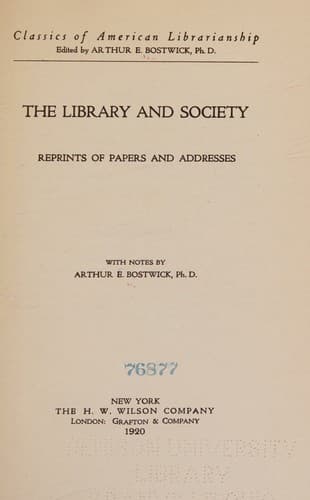
The Library and Society: Reprints of Papers and Addresses
History
The Library and Society: Reprints of Papers and Addresses
Libraries and society; Library science -- Social aspects
Supposing it were to become the custom of small libraries to send books
and pamphlets which they can get, but do not need, to large neighboring
libraries where they would be useful. Such action would lead to an
exchange of various civilities. Then, too, as the desirability of having
large libraries help smaller ones by loans of books becomes more and
more obvious, will not persons of means give money to the former to
enable them to do this kind of work for small towns generally or for
particular towns in which they may be specially interested?
Mr. Adams's advice to libraries is, not to accumulate books
promiscuously, but to practice a systematic differentiation in
collecting. Books which cumber the shelves of one library may be of the
greatest value in another. The public documents only of its own town and
State, and a few of the national documents relating to matters of
general interest, are in place in the library of a small town. But all
public documents have come to be of the greatest service in large
libraries and in libraries connected with important educational
institutions. Even those which seem driest, because exclusively of
statistics, are much in demand in colleges where students of history and
political economy are required to examine original sources.
Mr. Charles A. Cutter said several years ago, regarding the proper
disposition of pamphlets, that local pamphlets should be given to local
libraries, professional or scientific pamphlets to special libraries,
miscellaneous and all sorts of pamphlets to larger general libraries.
This is excellent advice.
Even large general libraries practice differentiation, many of them
excluding professional books and leaving special libraries in their
neighborhood to accumulate them. A State library may properly make a
specialty of public documents, and perhaps law books, and pay little
attention to accumulating other books. A general subscription library
with a constituency mainly of people of leisure may find it more useful
to collect books in belles-lettres, biography, history, travel, etc.,
than to buy many dealing with industrial subjects. But a public library
in a great manufacturing town, or a special library for architects and
engineers, must specialize on technical books.
It is not proposed to destroy books taken out of libraries where they
are not needed, but to place them within reach of those most needing
them, either through other libraries or auction rooms or secondhand
bookstores. No countenance would be given to such a proceeding as that
of the administrators of the estate of the well-known collector of old
books, Mr. T.O.P.H. Burnham, who are said to have sent a ton or more of
material from his stock to the paper mill.[5]
Public-domain text, read in full here on John Shaqi.
Reviews
Reviews
No reviews yet
Be the first to share your thoughts on this work.
Elsewhere in the archive
Join the Discussion
Join the discussion
Sign in to leave a comment or review.
Sign InorCreate an account