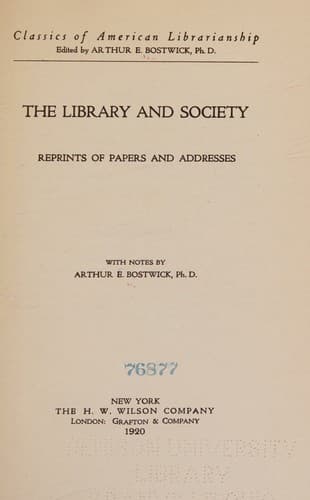
The Library and Society: Reprints of Papers and Addresses
History
The Library and Society: Reprints of Papers and Addresses
Libraries and society; Library science -- Social aspects
Broad-minded intelligence is needful for this kind of work, as well as
education and experience in library work. An expert is as much needed in
this work of weeding out as in selecting books for a library at its
start. Great harm might result from injudicious discarding.
Another objection likely to be made to the Quincy plan is that it would
often be difficult to decide how large a library is needed in a town or
city, and that this difficulty would be magnified in a growing town.
Still, if a thing is desirable it should be done in spite of
difficulties. Foresight must be exercised and generous provision made
for the probable growth of towns, and the number of volumes changed as
changes in the size of population or other considerations demand.
Supposing a mistake has been made, the weeding has been made with the
accessibility in view of large and special libraries in towns and cities
near by. Those towns and cities will still remain near to the town which
has grown unexpectedly large; their libraries will still be accessible
for reference. The difference between the old state of things and the
new is likely to be that the books will be used more under changed
circumstances than formerly.
But how provide under the Quincy plan for students who can not afford
time and money to frequent the large libraries even in towns or cities
near by; and supposing this number of special inquirers becomes
considerable, can you hope that they will receive a cordial welcome and
sympathetic assistance in large neighboring libraries? Dangers here
hinted at must be guarded against. Librarians and trustees should be on
the lookout for inquirers and help them to get at the books needed.
It is proposed to help them by preparing and issuing often improved
printed catalogs. Personal assistance would also evidently be needed
under the new plan. In some cases it would be necessary to buy books. In
others the investigator might be introduced to the officers of the
library, or by some influential person to the officers of a large
neighboring library with reference to his being allowed to borrow if he
could not use books on the premises. The same thing might perhaps be
better accomplished by a loan from the large to the small library. The
small library might have to pay for this privilege. It might be
desirable, if an investigator had leisure but not money, for the small
library to pay his car fare to the town where the library to be
consulted is situated.
Large libraries as now constituted are very obliging, and continually
extend courtesies to smaller institutions. The people of Worcester, for
example, every week, and sometimes oftener, have books borrowed for
their use from the Surgeon-General's library, Washington, from Harvard,
the Boston Athenæum, Columbia, Yale, and other libraries. Many
institutions are already extending gratuitously such privileges.
Public-domain text, read in full here on John Shaqi.
Reviews
Reviews
No reviews yet
Be the first to share your thoughts on this work.
Elsewhere in the archive
Join the Discussion
Join the discussion
Sign in to leave a comment or review.
Sign InorCreate an account