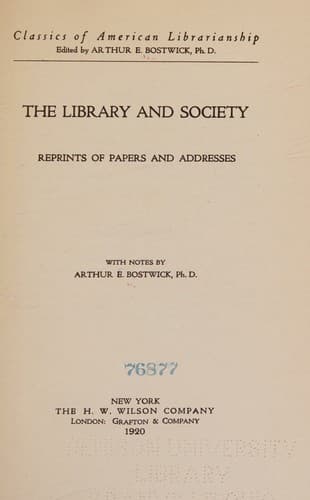
The Library and Society: Reprints of Papers and Addresses
History
The Library and Society: Reprints of Papers and Addresses
Libraries and society; Library science -- Social aspects
In the first place, that this percentage takes no account of reference
use, which is almost wholly of serious literature; second, that as to
home use the ratio in circulation of fiction to serious literature does
not represent a similar ratio of trivial to serious service. Fiction is
the small coin of literature. It must circulate more rapidly to
represent the same volume of real business done. A volume of fiction may
be issued, returned and reissued three times while a biography or
history or work of science is issued once. It will then count
seventy-five per cent. in the circulation. But the serious book has
during the entire period been out in the hands of the reader; and the
service which it has performed--the period of attention which it has
occupied--equals that of the novel in its three issues. And, finally,
there is to be considered the influence of the best fiction toward
general culture (if the library is not merely to inform but also to
cultivate)--in broadening the sympathies, giving a larger tolerance, a
kindlier humanity, a more intelligent helpfulness; in affording the rest
that is in itself an equipment for work, and the distraction that may
save from impulse to evil.
However, the amount of fiction circulated in proportion to the total
work of the library is on the average steadily decreasing. At the same
time the quality is improving; in part through critical selection, in
part as a happy result of the fact that the inferior novels are also, as
a rule, inferior books, so poorly manufactured that libraries cannot
afford to buy them.
But there is standard fiction and current fiction; and it is the current
fiction that constitutes by itself a special problem still perplexing.
It is a problem that concerns not the uneducated child, nor the
illiterate adult; it is caused by the people of intelligent education
who are avid to read the latest novel by Mr. X. or Mrs. Y. while it is
still the latest novel by Mr. X. or Mrs. Y. It is being talked about at
dinner or afternoon tea. Well-informed people are reading it; to read it
is a social necessity.
The reason that presses the public library to supply promptly every
most recent book in the domain of scientific literature is apparent
enough. Such literature contributes facts which are the data for action.
But novels in general belong to the literature of power. Their purpose
is not to furnish information but to give pleasure. Literature of this
sort adds no new fact, nor is it superseded, nor does it lose any of its
value by lapse of time. To assume that it does would be to assume that
beauty of form could become obsolete. This is not so in painting, in
sculpture, in architecture; why should it be so in prose fiction, in
poetry, in the drama? Was there, in fact, an aesthetic value in the
Canterbury Tales in 1380, in Hamlet in 1602, in Ivanhoe in 1819, that is
not to be found in them in 1898?
Public-domain text, read in full here on John Shaqi.
Reviews
Reviews
No reviews yet
Be the first to share your thoughts on this work.
Elsewhere in the archive
Join the Discussion
Join the discussion
Sign in to leave a comment or review.
Sign InorCreate an account