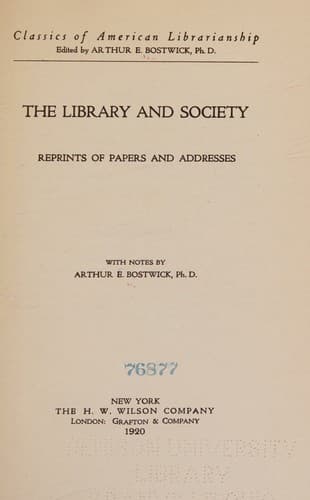
The Library and Society: Reprints of Papers and Addresses
History
The Library and Society: Reprints of Papers and Addresses
Libraries and society; Library science -- Social aspects
But a large portion of latter day fiction is fiction with a purpose;
another way of saying that it is a work of art composed for the
dissemination of doctrine. This element promotes it at once to the
dignity of a treatise; a new view of politics, a new criticism of social
conditions, a new creed! Here is something that concerns the student of
sociology. And surely his needs are worthy of prompt response.
In fact, his needs and the general curiosity do get prompt response, and
the new novels are freely bought. How freely I have recently sought to
ascertain. I asked of some seventy libraries their yearly expenditure
for current fiction in proportion to their total expenditure for books.
The returns show an average of from ten to fifteen per cent. In one case
the amount reached fifty per cent., in others it fell as low as two per
cent. The ratio for fiction in general is much higher on the average;
but fiction in general includes Scott and Thackeray and other standards,
an ample supply of which would not usually be questioned. At Providence
and Worcester, two of the most active and popular of public libraries,
the purchases of fiction, current and standard, formed last year but
seven and eleven per cent., respectively, of the entire expenditure for
books.
At Boston there were selected but 178 titles of current fiction (out of
nearly 600 read and considered). But some dozen copies were bought of
each title, so that the entire purchases reached 2,300 volumes and cost
about $2,300. This was about six and a half per cent. on a total
expenditure for books of $34,000. At St. Louis the practise is to buy
but two copies out of the general funds to be circulated free. Nearly a
hundred more are added which are rented out and thus pay for themselves.
The statistics do not seem to show that the initial expenditure for
current fiction is very alarming. But the purchase price of these books
is but a fraction of the expense of handling them. They cannot be
supplied in adequate quantities; for while the frenzy of curiosity
persists, an adequate supply is beyond the resources of any library. But
since the attempt to supply is futile the pretense is injurious. The
presence of the titles in the catalogues misleads the reader into a
multitude of applications which are a heavy expense to the library
without benefit to him. And the acquisition of the single book means to
the library the expense of handling a hundred applications for it which
are futile to one that can be honored. In this sense a current novel
involves perhaps a hundred times the expense of any other book in being
supplied to but the same number of readers.
The British museum acquires the new novels as published; but it
withholds them from the readers until five years after their date of
publication. It is my personal belief that a one year limitation of this
sort adopted by our free libraries generally would relieve them of
anxiety and expense and their readers of inconvenience and delusion.
Public-domain text, read in full here on John Shaqi.
Reviews
Reviews
No reviews yet
Be the first to share your thoughts on this work.
Elsewhere in the archive
Join the Discussion
Join the discussion
Sign in to leave a comment or review.
Sign InorCreate an account