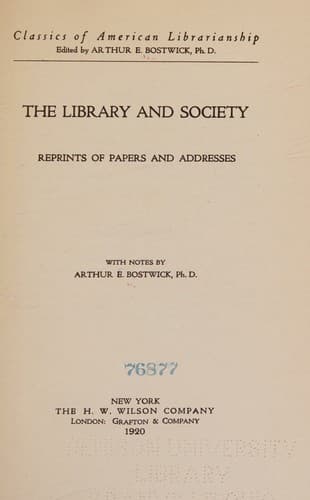
The Library and Society: Reprints of Papers and Addresses
History
The Library and Society: Reprints of Papers and Addresses
Libraries and society; Library science -- Social aspects
I believe that it will. And yet I do not see how the library can escape
exercising judgment. For there is no other responsible authority which
can be brought to exercise it. We must then expect numerous decisions
which will offend a portion of the community. They will usually be on
the conservative side--of exclusion. And it is for those who believe
that a public library should be a conservative influence in the
community to see that it has the authority and is protected in its
exercise.
Not that in respect of the violent books there is great injury in
present conditions. In the public libraries of to-day there exists no
doubt material sufficiently anarchic to upset society, if it could have
its will upon society. The fact is, that though there is plenty in
literature that is incendiary, there is little in our community that is
inflammable.
The good that the libraries do is obvious and acknowledged. They
represent the accumulated experience of mankind brought to our service.
They are the custodians of whatever is most worthy of preservation in
our own life and literature. They are the natural depositories of what
we have of memorial and of records; the original entries of legislation
and of achievement. They must render history available; they must
adequately exhibit science; they may help to refine by the best examples
in each art, and in this they may also contribute to the industrial life
of the community by educating the artisan into an artist, his craft into
an art. And through record and description of processes and inventions
they may contribute to the foundations of great industries. They touch
the community as a whole as perhaps does no other single organized
agency for good. They offer to the shyest ignorance equality with the
most confident scholarship, and demand no formal preliminary which might
abash ignorance.
They have a profound duty--not generally appreciated--to help render
homogeneous the very heterogeneous elements of our population. Thirty
per cent. of it has come to us from an alien life and alien
institutions. One-third of the people in our six leading cities are of
foreign birth; seventy-one per cent. were either born abroad or born of
foreign parentage. In the assimilation of this foreign element no single
agency is perhaps so potent as our public libraries.
Public-domain text, read in full here on John Shaqi.
Reviews
Reviews
No reviews yet
Be the first to share your thoughts on this work.
Elsewhere in the archive
Join the Discussion
Join the discussion
Sign in to leave a comment or review.
Sign InorCreate an account