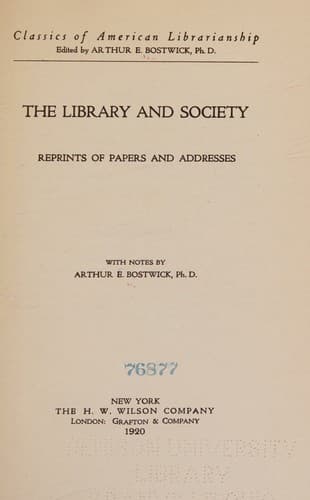
The Library and Society: Reprints of Papers and Addresses
History
The Library and Society: Reprints of Papers and Addresses
Libraries and society; Library science -- Social aspects
If, on the other hand, an authority is to be vested in the library, what
limits shall it set upon itself, upon what principles of discrimination
shall it proceed, in what directions may it expediently control? I but
state the problem. I shall not endeavor to answer it. But it is one of
the most important involved in the relation of the public library to the
community.
From such questions an ordinary educational institution stands aloof. It
is content to represent the judgment of the majority in matters of
morality and to inculate the lesson of tried truths as against untried
fancies in matters of opinion affecting the social order. It thus throws
its influence in favor of the established order of things. But its
right, nay, its duty, to do this is unquestioned. Nor is it regarded as
disparaging the opinion which it does not teach.
But a public library is not so exempt. In addition to the doctrine
which is accepted, it is held to have a duty to the opinion which is
struggling for recognition. As to minority opinion, it is not so much a
university as a forum. Nay, it is to give every advantage to minority
opinion, for--in our resentment of intolerance--minority opinion is not
merely tolerated, it is pampered.
Now, it is not for libraries or librarians to act as censors and
denounce this or that publication. Yet it is to be remembered that a
library which circulates a book helps to promulgate the doctrine which
the book contains. And if public libraries circulate books which teach
restless, irreverent or revolutionary doctrines, they offer us the
incongruity of a municipality aiding in the propagation of ideas which
are subversive of social order.
On the other hand, if there is to be exclusion on such grounds, where is
the line of exclusion to be drawn? Shall we say at doctrines which, if
carried into action, would be criminal under the law? Would the public
rest content with this?
Moreover, the principle of exclusion accepted, who is to apply it? Whose
judgment shall determine whether the particular book does or does not
offend? Shall the library determine? But will it not then be "dictating"
to its readers? Will it not be unduly discriminating against a certain
class of opinion when it has undertaken to represent impartially all
shades of opinion? Will it not offend the remonstrant against the
existing order of things who has a grievance, and, therefore, a right to
be heard; and the defender of the existing order of things who must know
the opinion in order to combat it; and the student of sociology whose
curiosity reaches all extremes and regards them simply as phenomena upon
which he is entitled to be informed?
Public-domain text, read in full here on John Shaqi.
Reviews
Reviews
No reviews yet
Be the first to share your thoughts on this work.
Elsewhere in the archive
Join the Discussion
Join the discussion
Sign in to leave a comment or review.
Sign InorCreate an account