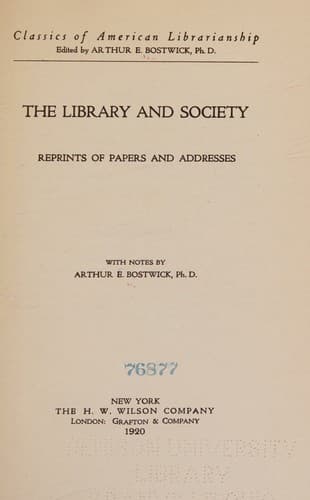
The Library and Society: Reprints of Papers and Addresses
History
The Library and Society: Reprints of Papers and Addresses
Libraries and society; Library science -- Social aspects
The experience of the Boston Public Library shows that in the case of
books each increase of facilities creates an increased demand. The
trustees of 1852 boasted that they were providing for as many as fifty
readers at a time; the trustees of 1887 thought themselves venturesome
in providing for 500 readers at a time; and within a month after the new
building was opened it was forced to accommodate over 700 at a time.
Every week over 30,000 persons enter the Central Library building, and
every year 1,200,000 volumes are drawn for home use by the 65,000
card-holders. Yet these figures represent still but a portion of the
persons reached and the work to be done. Nor can facilities for
distribution keep pace with the need. For a city of a half million
people spread over an area of forty square miles adequate library
facilities cannot ever be provided. A municipality which even
approximates the adequate in providing buildings, equipment,
administration and general literature at the public expense must still
look to private gift for the specialized material necessary to a great
reference collection. That the Boston Public Library is next to the
British Museum in Shakespeariana is, to be sure, the result of a special
expenditure by the city. But the larger part of its special collections
which have given it distinction as a great scholars' library, has come
from private gift; the Ticknor collection of Spanish literature, the
Bowditch collection of mathematics, the Chamberlain collection of
autographs, the Brown collection of music and many others. And a city
which erects for its public library a building which is monumental is
putting forward the most attractive invitation to private gift. The
gifts which have come to Boston as the direct result of the new building
have already reached a twelfth of its cost.
With proper organization and a liberal co-operation between municipal
and private effort the opportunities for service are almost limitless.
The risk is the greater of attempts at service either legally
inappropriate or practically inexpedient, and the risk is not lessened
by a popular appreciation which is more enthusiastic than it is apt to
be discriminating. There is, therefore, the greater need of
discrimination on the part of the library itself and of an authority
which will protect its exercise. This authority can be conferred only by
intelligent public opinion on the part of those who are capable of
appreciating constitutional limitations.
THE PUBLIC LIBRARY: ITS USES TO THE MUNICIPALITY
Written for the National Municipal League and printed in
_The Library Journal_ for June, 1903, eight years after the
author, Dr. John S. Billings, had begun his service as
director of the New York Public Library; largely a defence
of libraries against certain objections. The statement of
the part played by "sentiment" in popular institutions, and
its justification, are striking and true.
Public-domain text, read in full here on John Shaqi.
Reviews
Reviews
No reviews yet
Be the first to share your thoughts on this work.
Elsewhere in the archive
Join the Discussion
Join the discussion
Sign in to leave a comment or review.
Sign InorCreate an account