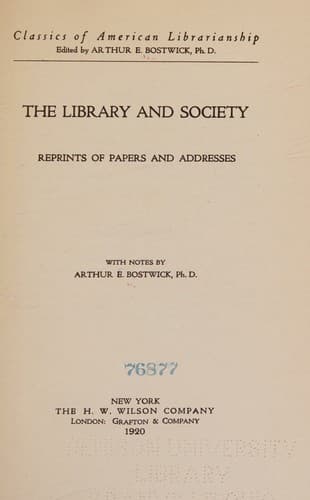
The Library and Society: Reprints of Papers and Addresses
History
The Library and Society: Reprints of Papers and Addresses
Libraries and society; Library science -- Social aspects
John Shaw Billings was born in Switzerland County, Ind., in
1839, graduated from Miami University in 1857, studied
medicine and after serving as a surgeon in the Civil War,
was assigned to the Surgeon General's Office in Washington,
of whose library he compiled the 16-volume Index Catalogue.
After service in Johns Hopkins and Pennsylvania Universities
he was chosen in 1895 director of the newly established New
York Public Library, where he served until his death in
1913, planning and supervising the construction of its
central building.
The great majority of cities of 25,000 inhabitants and upward in the
United States have public libraries of some sort, and the same is true
of many of the smaller cities. Many of these libraries have been founded
on gifts of individuals, some have developed from subscription
libraries, but the majority are now supported mainly or entirely by
funds appropriated by the city government. A considerable number are
still in the formative stage, this being true of those for which
buildings are being erected from funds provided by Mr. Carnegie and for
several hundred others for which he will probably provide buildings in
the near future.
There may be excessive and unjustifiable taxation for the support of a
public library--the amount which the city can afford for this purpose
should be carefully considered in connection with its needs for a pure
water supply and good sewage disposal, for means of communication, for
the care of the sick poor and for public schools. Each case must be
judged by itself; the only general rule I have to suggest is that in the
department of education the claims of the public library for support are
more important than those of municipal college or high school. The
people who have no taxable property, and who therefore often erroneously
suppose that they contribute nothing toward the payment of the taxes,
are usually quite willing to have a higher tax rate imposed for the
purpose of securing for themselves and their families free library
facilities--although in exceptional cases religious or sociological
opinions may lead them to oppose it.
A considerable number of taxpayers on the other hand, are more or less
reluctant to have their assessments increased for this purpose, and
their arguments should be considered and met. They are:
1. That they should not be taxed for things they do not want and never
use.
2. That furnishing free books tends to pauperize the community and to
discourage the purchase of books for home use.
3. That there is no evidence that free public libraries improve the
community materially or morally.
4. That the greater part of the books used are works of fiction and that
these are injurious to the readers.
5. That most of the arguments used in favor of free public libraries are
merely sentimental and emotional.
Public-domain text, read in full here on John Shaqi.
Reviews
Reviews
No reviews yet
Be the first to share your thoughts on this work.
Elsewhere in the archive
Join the Discussion
Join the discussion
Sign in to leave a comment or review.
Sign InorCreate an account