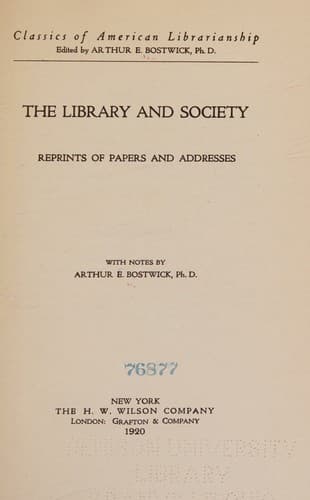
The Library and Society: Reprints of Papers and Addresses
History
The Library and Society: Reprints of Papers and Addresses
Libraries and society; Library science -- Social aspects
The first of these reasons would apply also to taxes for public schools,
street paving, sewerage, and many other items of municipal expenditure
and has no weight.
With regard to the second argument it is not a sufficient reply to say
that every one pays through the taxes, for this would apply equally well
to free lodging houses, free lunchrooms and soup kitchens, free fuel,
etc., all of which it generally believed tend to pauperize a city,
except in great and special emergencies. The proper answer is that the
free public library is an important and, indeed, necessary part of the
system of free education which is required to secure intelligent
citizens in our form of popular government, and that while in a few very
exceptional cases free schools and free libraries may tend to
improvidence or indolence or even to certain forms of crime, these rare
cases are of no importance in comparison with the benefits which
education confers upon the immense majority of the community and with
the fact that without free schools and libraries a large part of the
people will not be sufficiently educated to be useful citizens.
With the regard to the third count, the public library, again, may be
considered together with the public school. While it is difficult to
trace to either specific instances of material or moral improvement, it
is certain that the general diffusion of intelligence which both
certainly effect does result beneficially in these directions.
Communities with flourishing free schools and libraries are usually more
prosperous and better than those without such facilities, and, while
there is doubtless room here for a confusion of cause and effect, it is
probable that there is both action and reaction. Prosperity calls for
increased facilities for education and these in turn tend to make the
community more prosperous.
That the majority of books withdrawn from public libraries are works of
fiction cannot be denied. Many librarians are wont to deplore this fact,
and most libraries endeavor in one way or another to decrease the
percentage of fiction in their circulation.
The proportion of recreative reading in a public library is necessarily
large. In like manner, the greater proportion of those who visit a
zoological or botanical garden do so for amusement. Yet the information
that they secure in so doing is none the less valuable and both are
certainly educational institutions. So if in the public library a large
number of its users get their history, their travel and their biography
through the medium of recreative readings we should not complain. Were
it otherwise these readers would probably lack altogether the
information that they now certainly acquire.
Public-domain text, read in full here on John Shaqi.
Reviews
Reviews
No reviews yet
Be the first to share your thoughts on this work.
Elsewhere in the archive
Join the Discussion
Join the discussion
Sign in to leave a comment or review.
Sign InorCreate an account