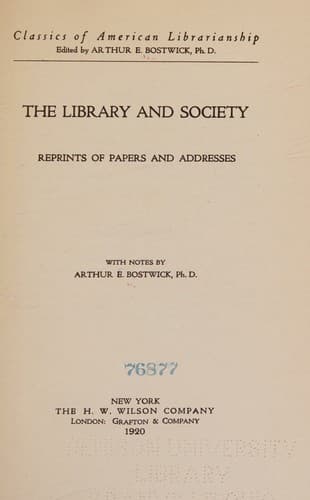
The Library and Society: Reprints of Papers and Addresses
History
The Library and Society: Reprints of Papers and Addresses
Libraries and society; Library science -- Social aspects
By way of introduction to the comprehensive addresses of the two
distinguished delegates who have travelled four or five thousand miles
to lay before this Section, and, through publication, before the world,
the past history and the present problems of the library, it has seemed
to me appropriate that, as chairman, I should present a brief plea for
the consideration of the library as one of the greatest factors in human
progress. It has existed, though not in its present form or with its
present functions, from the dawn of recorded civilization. It is itself
the record of civilization; and without it there can be no records and
no civilization. It is the repository, the custodian, the preserver of
all the arts and sciences and the principal means of disseminating all
knowledge. With the school and the church it forms the tripod necessary
to the stable equilibrium of society. Let me briefly summarize the
functions of the public library.
1. It doubles the value of the public school instruction, on which is
expended more than ten times the cost of the library.
2. It enables the children who leave school at an early age (an
overwhelming majority) to continue their education while earning their
living. It provides for the education of the adults who have lacked or
failed to utilize early opportunities. This is of special importance in
a country like the United States, where one of the greatest political
problems is the assimilation of a vast influx of ignorant foreigners of
all races and languages.
3. It supplies books and periodicals needed for the instruction of
artisans, mechanics, manufacturers, engineers, and all others whose work
requires technical knowledge[6]--all persons on whom depends the
industrial progress of the community.
4. It furnishes information and inspiration to ministers, teachers,
journalists, authors, physicians, legislators--all persons on whose work
depend the intellectual, moral, sanitary, political and religious
welfare and advancement of the people.
5. It is the stimulus and the reliance of the literary and study clubs,
which, especially among the women, have done much not only for
individual self-culture but also for civic enlightenment and social
betterment. This represents its numerous post-graduate courses, which
are taken by constantly increasing numbers.
6. It has philosophers and theologians to explain and expound and to
exhort those who are willing to listen; but, far better, it has poets
and dramatists and novelists--who compel a hearing and impress on heart
as well as mind the fundamental truths of morality and religion.
Public-domain text, read in full here on John Shaqi.
Reviews
Reviews
No reviews yet
Be the first to share your thoughts on this work.
Elsewhere in the archive
Join the Discussion
Join the discussion
Sign in to leave a comment or review.
Sign InorCreate an account