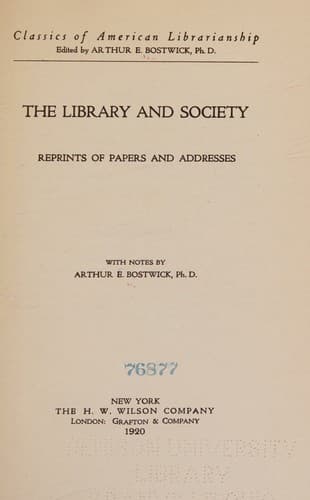
The Library and Society: Reprints of Papers and Addresses
History
The Library and Society: Reprints of Papers and Addresses
Libraries and society; Library science -- Social aspects
7. It is also a school of manners, which have been well defined as minor
morals. The child learns by example and by the silent influence of his
surroundings; and every visit to a library is a lesson in propriety and
refinement. The roughest boy or the rudest man cannot fail to be
impressed by the library atmosphere and by that courtesy which is the
chief element in the "library spirit."
8. It imparts, as the school cannot, knowledge of one's self, and of
one's relations to one's fellow-man, and thus prepares the individual
for citizenship and fellowship in organized society and leads him to be
an active force in social advancement.
9. It elevates the standard of general intelligence throughout the
community, on which depends its material prosperity as well as its moral
and political well-being.
[6] The information furnished by a book in the Cincinnati Public
Library once saved that city a quarter of a million dollars. This in
numerous instances, but on a smaller scale, is a part of the everyday
work of the library.
10. But not last, if an exhaustive list were aimed at--nor least it
supplies a universal and urgent craving of human nature by affording to
all entertainment of the highest and purest character, substituting this
for the coarse, debasing, demoralizing, amusements which would otherwise
be sought and found. Further, it brings relief and strength to many a
suffering body and cheer and solace to many a sorrowing heart. It is
instruction and inspiration to the young, comfort and consolation to the
old, recreation and companionship to all ages and conditions.
I close as I began:
Education is the greatest concern of mankind; it is the foundation of
all human progress. The library is an essential factor in all grades of
education; and it is the agent plenipotentiary in the betterment of
society and the culture and cheer of the human soul. "The highest gift
of education is not the mastery of sciences, but noble living, generous
character, the spiritual delight that comes from familiarity with the
loftiest ideals of the human mind, the spiritual power that saves each
generation from the intoxication of its own success."
THE LIBRARY AS A FACTOR IN MODERN CIVILIZATION
Read by President Faunce of Brown University, at the
Narragansett Pier Conference of the American Library
Association in 1906. Elaborates the library's three gifts to
the nation--"knowledge, perspective and ideals."
William Herbert Perry Faunce was born in Worcester, Mass.,
Jan. 15, 1859, graduated at Brown University in 1880,
entered the Baptist ministry, and after holding several
pastorates became in 1899 president of his alma mater. He is
known as an effective writer and speaker, especially on
religion and education.
Public-domain text, read in full here on John Shaqi.
Reviews
Reviews
No reviews yet
Be the first to share your thoughts on this work.
Elsewhere in the archive
Join the Discussion
Join the discussion
Sign in to leave a comment or review.
Sign InorCreate an account